I love this joke:
A: "I'm sorry--- I quite forgot your party the other evening!"
B: "Oh, weren't you there?"
I'm always the type of person who are treated in this way (TEAR).
8/02/2007
7/29/2007
No Justice 2
In Aljazeera English, you can read views on the Koreans abducted by the Taliban.
I don’t think the Taliban can justify what they are doing because they are doing that to Koreans. Can the Taliban admit Koreans do the same thing to Muslims living in other areas because they are categorized into Islamite? A Japanese young man was also killed there. He was blamed for taking a trip there though he was warned not to go there. I should admit he made a mistake but the persons who killed the Japanese must be charged more bitterly with their killing him.
I don’t think the Taliban can justify what they are doing because they are doing that to Koreans. Can the Taliban admit Koreans do the same thing to Muslims living in other areas because they are categorized into Islamite? A Japanese young man was also killed there. He was blamed for taking a trip there though he was warned not to go there. I should admit he made a mistake but the persons who killed the Japanese must be charged more bitterly with their killing him.
7/28/2007
No Police 2
Last week, six party talks adjourned to require North Korea and the neighbours to meet the requirements. NK will get so much oil and dismantle nuclear program in return, while Japan is required to show less hostility toward NK on abduction issue, and the US take the name of NK out of the list of goverments supporting terrorists, according to Washingtonpost. The neighbours gave a villain what it wanted because the villain threatened them with nuclear programme. Even in the international situation in which diverse values go, do you think the neighbors made a right decision?
Related article: No Police
Related article: No Police
6/06/2007
Layman's Question
My favorite Japanese artist, Okamoto Taro, frequently said, "Be a layman." I guess he meant by this phrase that you should have a direct view into objects, letting nothing intervening between the objects and you. Probably, we have some assumptions on which our social lives go easily, but they sometimes prevent you from seeing the truths and making good decisions.
For example, when old persons insist that they need enough money to let them live peacefully, they seem to forget that theri request would impose big burden on their children and being destined to pass away soon. They are the members of the community, so they need to find a fair way to distribute money and foodstuff to the members of the community.
This came to me when Okamoto told me a story about a system adopted by Eskimoans as to how to reduce the number of the older persons in the society. They, turning some age, are required to throw themselves into the sea. If one of them has not drown to death, his grandaughter who was cherished by her grandfather will put his head under the water, saying "Thank you and good-bye."
I don't mean older persons should be useless. An extreme view may let us see problems in perspective, consequently to let you know your life depends upon the society in which you're living. No one knows the meaning and significance of life. Without knowing this, how can you choose your own way to live and spend your time living in this world. This awareness, I believe, will lead us to live less greedily and arrogantly.
"Be a layman" is one of my favorite words. I'm professional, so I need to keep this in my mind, like other professionals in power.
6/05/2007
Sentenced to Freedom
In a sense, philosophy tells you that you cannot have an objective view on anything you think existing in the world. In short, you have a very limited view of the world in which you are living now.
In this limited view, some of you, including me, should try to find a better way to spend your time in this world. This type of persons are categorized into existentialists by Heidegger.
In this limited view, some of you, including me, should try to find a better way to spend your time in this world. This type of persons are categorized into existentialists by Heidegger.
As an existentialist, I have found Sartre's existentialism and Buddhistic philosophy, but they just tell you "you're sentenced into freedom," "you have no doctrine to cling to in living in the world but to think, more exactly, to struggle.
Recently, I've found myself in impasse. I know this is common, and I need to do what I should do.
6/03/2007
Barbarians
Japan Argues to Hunt Minke Whales (washingtonpost)
Moratorium on Commercial Whaling Upheld (washingtonpost)
This news has reminded me of the words of Claude Levi-Strauss about "barbarian." The persons called "barbarians," he said, should refer to the ones who do not accept anything they are not familiar with. Before, Japanese found it strange that some westerners eat cattle, but have accepted them as food. You know, what you should live on depends upon its geographical environment. Japan has been an isolated island country where they have found foodstuff peculiar to the island. It seems to me that anti-whaling factions have something hidden against Japan in their minds. Let me call them barbarians.
If you have questions as to the status quo of whales, go to the website.
Moratorium on Commercial Whaling Upheld (washingtonpost)
This news has reminded me of the words of Claude Levi-Strauss about "barbarian." The persons called "barbarians," he said, should refer to the ones who do not accept anything they are not familiar with. Before, Japanese found it strange that some westerners eat cattle, but have accepted them as food. You know, what you should live on depends upon its geographical environment. Japan has been an isolated island country where they have found foodstuff peculiar to the island. It seems to me that anti-whaling factions have something hidden against Japan in their minds. Let me call them barbarians.
If you have questions as to the status quo of whales, go to the website.
5/08/2007
Siva's View 5: Kamakura
The Kamakura period (1192-1333) is important in Japanese history for two remarkable facts: the establishment of the government by the pioneer peasants and the emergence of religious sects for them. These two were the first in the world then.
As doctuments shows, in the Nara and Heian periods, you haven't found any trace of the peasants living and contributing to the governmetal system. They are thought to have been like slaves; I mean, they were allotted land and forced to grow crops for aristocracy.
In the second half of Heian period, some of the slaves ran away and pioneered into the Kanto area, called Bando then; there, they needed to protect their own land and lordship, so they began to carry arms with them. They are thought to have been the first Samurai (Japanese warrior).
A problem emerged then. The aristocrats in Kyoto, the former capital of Japan, tried to get them under their control, so they needed to protect their own land, followed by a war between Bando and Kyoto. The Bando won.
The leader of the peasants in Bando, Minamoto Yoritomo, took the soverinity from Mikado, the former name of Tenno or Emperor in Japanese (the word, emperor, cannot regarded as the exact word to translate "Mikado" into English; I will explain later) and opened the new government in Kamakura, the beginning of the Kamakura period, which you can call the second stage in Japanese history, the feudal system.
Through these events, the Bando peasants began to think about their own life. Every individual dies, but they try to survive. This contradictory movements in which persons are always must have been gazed at by them, and they needed to get a new kind of philosophy to see the world.
Then several Buddhistic sects were born, of which the two extreme sects were Jo-do Shinshu and Zen in the sense the former tells you to know your ignorance and impotence to upgrade you to a person with wisdom while the latter convinces you that your exaltation is the only way to give you the wisdom.
As doctuments shows, in the Nara and Heian periods, you haven't found any trace of the peasants living and contributing to the governmetal system. They are thought to have been like slaves; I mean, they were allotted land and forced to grow crops for aristocracy.
In the second half of Heian period, some of the slaves ran away and pioneered into the Kanto area, called Bando then; there, they needed to protect their own land and lordship, so they began to carry arms with them. They are thought to have been the first Samurai (Japanese warrior).
A problem emerged then. The aristocrats in Kyoto, the former capital of Japan, tried to get them under their control, so they needed to protect their own land, followed by a war between Bando and Kyoto. The Bando won.
The leader of the peasants in Bando, Minamoto Yoritomo, took the soverinity from Mikado, the former name of Tenno or Emperor in Japanese (the word, emperor, cannot regarded as the exact word to translate "Mikado" into English; I will explain later) and opened the new government in Kamakura, the beginning of the Kamakura period, which you can call the second stage in Japanese history, the feudal system.
Through these events, the Bando peasants began to think about their own life. Every individual dies, but they try to survive. This contradictory movements in which persons are always must have been gazed at by them, and they needed to get a new kind of philosophy to see the world.
Then several Buddhistic sects were born, of which the two extreme sects were Jo-do Shinshu and Zen in the sense the former tells you to know your ignorance and impotence to upgrade you to a person with wisdom while the latter convinces you that your exaltation is the only way to give you the wisdom.

5/03/2007
Constitution
Since May 3rd, 1947, Japan has had the current constitution, which might change to activate the Japan Army under the present Prime Minister regime. Recently, there has been talk about whether it should be revised. Most crucial in the talk seems to be the ninth article: Japan does not have any force effective to handle international conflicts.
The problem is on how to intepret the international conflicts, or, more directly, if the purpose of self-defense will be categorized into international conflict. This is a gray zone susceptible to some interpretations. This room was the cause of our WWII, concluded by some of us. The room gives persons in power the choice to interpret and lets them run.
It is nonsense to try to choose one of the two views: the first that war or violence cannot work as a way to solve conflicts among nations but to conclude and the second we need to have the capacity to protect our country and the world peace from countries that will try to handle matters with power. Because both of them are right. History tells us wars have killed guilty and innocent persons indiscriminately and good and righteous persons are not always superior to evil persons in power.
The two views can remain intact in the current ninth article; therefore, I conclude we should not change the constitution. The problem is not the constitution but how we can use it, so we must be deliberate when electing the representatives among whom the prime minister will be selected. More important, any person, however diligent and deliberate they are, can make mistakes in many cases, so you have to realize each of you should be responsible for the decision our leader you have elected has made.
The problem is on how to intepret the international conflicts, or, more directly, if the purpose of self-defense will be categorized into international conflict. This is a gray zone susceptible to some interpretations. This room was the cause of our WWII, concluded by some of us. The room gives persons in power the choice to interpret and lets them run.
It is nonsense to try to choose one of the two views: the first that war or violence cannot work as a way to solve conflicts among nations but to conclude and the second we need to have the capacity to protect our country and the world peace from countries that will try to handle matters with power. Because both of them are right. History tells us wars have killed guilty and innocent persons indiscriminately and good and righteous persons are not always superior to evil persons in power.
The two views can remain intact in the current ninth article; therefore, I conclude we should not change the constitution. The problem is not the constitution but how we can use it, so we must be deliberate when electing the representatives among whom the prime minister will be selected. More important, any person, however diligent and deliberate they are, can make mistakes in many cases, so you have to realize each of you should be responsible for the decision our leader you have elected has made.
4/22/2007
Easier Solution
I don't want to conclude the shootings in Virginia Tech must have been attributed to just abnormality in the person because discontent should lead to such abrupt massacre in some cases. I think we must recognize the current society has been incomplete, and such awareness may bring something to prevent another tragedy from assaulting us not you. I haven't organized my thought, but I'm sure it should be the first step into a possible better reformation of some part in the society.
3/15/2007
Stookey Songs for the Abuductee
Here, you can listen to the song for Yokota Megumi, abducted by North Korean agents, composed by Paul Stookey.
Related article: No Justice
Related article: No Justice
3/08/2007
NO COMFORT?
Did you read the articles in NY Times, L.A. Times, and Bostonglobe about the sex slaves?
I was disappointed to read them because the writers seem to have written them before seeing the issue in perspective.
According to me, Japan will appologize and accept the call (though it apoligized more than once) if it is based on fair judgment and investigation into the truth, in correct judicial proceedings. But I don't think it is fair to charge a suspected person with the alleged atrocity its accusers describe.
More important, it doesn't matter if the Korean's explanation is true or not. What matters most should be found in "Agreement on the Settlement of Problem concerning Property and Claims and the Economic Cooperation between the Japan and Republic of Korea."
South Korea, in normalizing relationship with Japan after the World War II, stated that it would take care of all of the Korean individuals who were victimized by the Japan Army, taking 300 million dollars and more from Japan, as the compensation. Sadly, the Korean government spent all the money for developing the country, without gaining permission from the nation.
I was disappointed to read them because the writers seem to have written them before seeing the issue in perspective.
According to me, Japan will appologize and accept the call (though it apoligized more than once) if it is based on fair judgment and investigation into the truth, in correct judicial proceedings. But I don't think it is fair to charge a suspected person with the alleged atrocity its accusers describe.
More important, it doesn't matter if the Korean's explanation is true or not. What matters most should be found in "Agreement on the Settlement of Problem concerning Property and Claims and the Economic Cooperation between the Japan and Republic of Korea."
South Korea, in normalizing relationship with Japan after the World War II, stated that it would take care of all of the Korean individuals who were victimized by the Japan Army, taking 300 million dollars and more from Japan, as the compensation. Sadly, the Korean government spent all the money for developing the country, without gaining permission from the nation.
2/14/2007
No Police
I'm stunned that Six Party Talk has ended in that way. What a deal is it that Norht Korea would be offered much oil while letting them know and permitting IAEA to inspect the institutions where nuclear weapons are said to have been produced! Neither justice nor cause-and-effect coherence can be found there. North Korea would not lose anything while the other countries would pay.
What they are saying is Japan needs to have nuclear weapons to claim the abductees should be returned to their home country. And I will tell China and South Korea that they haven't been qualified to blame Japan for what it did because they have allowed North Korea to do the same evil things as the alleged atrocities Japan did against them during the first half of the 20th century. Evil is evil. In their countries, can they tell their children the resolution can be called fair?
North Korea, I'm adamant, must be a regular rogue toward civilians. The world has no police to arrest villains. The US may have failed in Iraq but should not have learned how he made the mistake. In both cases, no justification in cutting deals has been made. North Korea is one of those countries like Russia, as described in "Potemkin Justice"(Washingtonpost), though it's much poor in power and quality.
P.S. A Good Deal with North Korea (Boston Blobe), Nuclear Bargaining and U.S. Flexibility Credited in Nuclear Deal With N. Korea (Washingtonpost), Pact With North Korea Draws Fire From a Wide Range of Critics in U.S. (New York Times).
What they are saying is Japan needs to have nuclear weapons to claim the abductees should be returned to their home country. And I will tell China and South Korea that they haven't been qualified to blame Japan for what it did because they have allowed North Korea to do the same evil things as the alleged atrocities Japan did against them during the first half of the 20th century. Evil is evil. In their countries, can they tell their children the resolution can be called fair?
North Korea, I'm adamant, must be a regular rogue toward civilians. The world has no police to arrest villains. The US may have failed in Iraq but should not have learned how he made the mistake. In both cases, no justification in cutting deals has been made. North Korea is one of those countries like Russia, as described in "Potemkin Justice"(Washingtonpost), though it's much poor in power and quality.
P.S. A Good Deal with North Korea (Boston Blobe), Nuclear Bargaining and U.S. Flexibility Credited in Nuclear Deal With N. Korea (Washingtonpost), Pact With North Korea Draws Fire From a Wide Range of Critics in U.S. (New York Times).
11/05/2006
Against Russia
Japanese fisherboats were taken to Russia for their alleged operations (I don't know what they have done!). A couple of months ago, a Japanese fisherboat was also assaulted and one of the crews was shot dead for their ill management and in a Russian court the captain was told to admit they were doing something in the wrong place and pay a penalty of about 1500,000 yen, or he would not be home. Reading some articles concerning this in BBC, I would be lured to conclude Russia was trying to build a borderline between Japan and Russia around the Japanese Nothern territory which was taken from Japan after the WWII, in order to silence the fact that the territory was illegitimately belonging to Russia.
10/18/2006
What is a Faulknerian?
I didn't know I had been deeply immersed in Faulkner's spirit until I was required to answer to the question by one of my girlfriends of why I'm so pessimistic. I answered, "I'm not pessimistic, but just a Faulknerian," by which I meant we're required to see the whole scene of human experience in transformation, in which each individual is trapped in his own past.
8/15/2006
To the World
To the World Whom it May Concern,
Japan seems to have been charged with its alleged attempts to whitewash the atrocities it committed during the wars in the first half of the 20th century. Some have found three symptoms of its kind in 1) some of the descriptions in the Japanese history textbooks, 2) the Japanese insistence on its own dominion over Takeshima (alleged by Korea), and 3) the present Japanese Prime Minister’s frequent visits to Yasukuni Shrine. However, I wonder how these can be regarded as the symptoms because I observe they are just indicative of Japan’s repentance and responsibility for what it did in the wars, and its results. In another expression, Japan has a firm determination not to appeal to arms to resolve international conflicts with any other countries. So, I don’t understand how those interpretations can go so far. Let me try to rectify the misunderstandings.
1) As to the Descriptions in textbooks
Again, one of the biggest lessons the wars gave Japan was you should not appeal to arms to handle international affairs because a war is just a competition in arm, so it cannot work as a way to judge what is right over a matter in question. This must have been an axiom to Japan, but our (great-) grandfathers were driven to the wars. Why? Japan thinks it necessary to study more about the international wars in the first half of the previous century, to trace how he forced himself to participate in the wars, the Shino-Japanese war and the Pacific War, whose whole picture, according to researchers, has remained incomplete. Some attribute its decisive cause to the Japanese being extremely evil. But Japan thinks it is just a layman’s answer. A factual survey of Japan’s actions during the wars shows he did so many things, some of which should be categorized as bitter wrongdoings and others should not. Some persons think the latter actions should not be described in the textbooks, but Japan wants to get a whole picture of the wars to trace the true cause(s) of the biggest tragedy that the world had ever had, so those descriptions need to be in the textbooks, in order to let the students see the wars in perspective.
2) Takeshima (Dokto)
Which country has the authorized dominion over Takeshima (Dokto)? This has been difficult to settle because there has been no clear logic in showing who the true owner of the island has been. In the beginning, what can give the authority to either of them? Is it factual records or documents? They cannot because they are just pieces of information, so they cannot give an unerring answer to the problem, so that each of the two countries is allowed to cling to his own assertion while ignoring the opponent’s statement. What should they do then? One of the most possible solutions might be to ask the International Court of Justice for help. Japan suggested doing so, but Korea has refused to agree. I don’t know why.
What I want to let Korea know most is that Korea is doing the same thing as Japan did against Korea before. Korea has put its army in Takeshima to prevent any Japanese civilian fishermen from approaching to the island. In short, Korea has appealed to arms to handle international affairs. I suggest Korea should leave the Takeshima matter to the International Court of Justice. Let me tell you Japan is not going to handle this matter with weapon.
3) Yasukuni Shrine
I would say this is a matter of intercultural conflict. So, I think Japan needs to describe and delineate how Shinto, a Japanese idiosyncratic religion, lets Japanese pay homage at the shrine. Those who have criticized the Japanese Prime Minister’s frequent visits to Yasukuni Shrine, I’m saying, do not know what the visits mean. Do you know Shinto has no doctrine to cling to and its reason? There are so many religions in the world, but they look the same in that they may help us understand or accept a fact complicated, unfathomable, and susceptible to several readings, like why we are mortal, why my baby was gone at his or her birth, why I have had no leg since I was born, why a person whom I thought honest and sincere kills another person, etc. You can say that the kind of fact should be a phenomenon in which two or more opposite interpretations can go. On the contrary, the religions are different from each other in their ways to help or let persons understand or accept those facts. I’m saying some who criticize the visits are ignorant of the way adopted in Shinto.
An event becomes a problem to you when the event collides with the one you have had. Can you guess what Shinto requires you to do then? It advises you to let those incompatible things coexist peacefully and tranquilly. In Shinto, “praying” is correspondent in meaning with not “admiring or worshipping someone” but “contemplating the kind of situation in which there are two or more things that are inconsistent with each other.” More important, the wars were an amalgam of so many phases: Japan competed with and was lost to US in the Pacific War while Japan invaded China in the Shino-Japan War like the Powers did in the world then, and the Japanese leaders committed awful mistakes in adopting strategies and made so many Japanese soldiers die in vain though they did not intend (they were not wise enough). To Japanese, those were mingled indistinctively in the wars. You should not see just one element, or you would not be able to see the wars in wider perspective. I would say that the Japanese Prime Minister praying at Yasukuni Shrine indicates an attempt to let the whole disastrous wars remain in the Japanese minds, including Japan’s remorsefulness over having made so many mistakes and their results, distress and anguish, and his grief and lamentation for those who were forced to live and survive in the Dark Age.
NY Times(August 14, 1945)
Townhall (August 20, 2006)
Japan seems to have been charged with its alleged attempts to whitewash the atrocities it committed during the wars in the first half of the 20th century. Some have found three symptoms of its kind in 1) some of the descriptions in the Japanese history textbooks, 2) the Japanese insistence on its own dominion over Takeshima (alleged by Korea), and 3) the present Japanese Prime Minister’s frequent visits to Yasukuni Shrine. However, I wonder how these can be regarded as the symptoms because I observe they are just indicative of Japan’s repentance and responsibility for what it did in the wars, and its results. In another expression, Japan has a firm determination not to appeal to arms to resolve international conflicts with any other countries. So, I don’t understand how those interpretations can go so far. Let me try to rectify the misunderstandings.
1) As to the Descriptions in textbooks
Again, one of the biggest lessons the wars gave Japan was you should not appeal to arms to handle international affairs because a war is just a competition in arm, so it cannot work as a way to judge what is right over a matter in question. This must have been an axiom to Japan, but our (great-) grandfathers were driven to the wars. Why? Japan thinks it necessary to study more about the international wars in the first half of the previous century, to trace how he forced himself to participate in the wars, the Shino-Japanese war and the Pacific War, whose whole picture, according to researchers, has remained incomplete. Some attribute its decisive cause to the Japanese being extremely evil. But Japan thinks it is just a layman’s answer. A factual survey of Japan’s actions during the wars shows he did so many things, some of which should be categorized as bitter wrongdoings and others should not. Some persons think the latter actions should not be described in the textbooks, but Japan wants to get a whole picture of the wars to trace the true cause(s) of the biggest tragedy that the world had ever had, so those descriptions need to be in the textbooks, in order to let the students see the wars in perspective.
2) Takeshima (Dokto)
Which country has the authorized dominion over Takeshima (Dokto)? This has been difficult to settle because there has been no clear logic in showing who the true owner of the island has been. In the beginning, what can give the authority to either of them? Is it factual records or documents? They cannot because they are just pieces of information, so they cannot give an unerring answer to the problem, so that each of the two countries is allowed to cling to his own assertion while ignoring the opponent’s statement. What should they do then? One of the most possible solutions might be to ask the International Court of Justice for help. Japan suggested doing so, but Korea has refused to agree. I don’t know why.
What I want to let Korea know most is that Korea is doing the same thing as Japan did against Korea before. Korea has put its army in Takeshima to prevent any Japanese civilian fishermen from approaching to the island. In short, Korea has appealed to arms to handle international affairs. I suggest Korea should leave the Takeshima matter to the International Court of Justice. Let me tell you Japan is not going to handle this matter with weapon.
3) Yasukuni Shrine
I would say this is a matter of intercultural conflict. So, I think Japan needs to describe and delineate how Shinto, a Japanese idiosyncratic religion, lets Japanese pay homage at the shrine. Those who have criticized the Japanese Prime Minister’s frequent visits to Yasukuni Shrine, I’m saying, do not know what the visits mean. Do you know Shinto has no doctrine to cling to and its reason? There are so many religions in the world, but they look the same in that they may help us understand or accept a fact complicated, unfathomable, and susceptible to several readings, like why we are mortal, why my baby was gone at his or her birth, why I have had no leg since I was born, why a person whom I thought honest and sincere kills another person, etc. You can say that the kind of fact should be a phenomenon in which two or more opposite interpretations can go. On the contrary, the religions are different from each other in their ways to help or let persons understand or accept those facts. I’m saying some who criticize the visits are ignorant of the way adopted in Shinto.
An event becomes a problem to you when the event collides with the one you have had. Can you guess what Shinto requires you to do then? It advises you to let those incompatible things coexist peacefully and tranquilly. In Shinto, “praying” is correspondent in meaning with not “admiring or worshipping someone” but “contemplating the kind of situation in which there are two or more things that are inconsistent with each other.” More important, the wars were an amalgam of so many phases: Japan competed with and was lost to US in the Pacific War while Japan invaded China in the Shino-Japan War like the Powers did in the world then, and the Japanese leaders committed awful mistakes in adopting strategies and made so many Japanese soldiers die in vain though they did not intend (they were not wise enough). To Japanese, those were mingled indistinctively in the wars. You should not see just one element, or you would not be able to see the wars in wider perspective. I would say that the Japanese Prime Minister praying at Yasukuni Shrine indicates an attempt to let the whole disastrous wars remain in the Japanese minds, including Japan’s remorsefulness over having made so many mistakes and their results, distress and anguish, and his grief and lamentation for those who were forced to live and survive in the Dark Age.
NY Times(August 14, 1945)
Townhall (August 20, 2006)
7/27/2006
Chi
Did you hear about CHI, seen in Dragon Ball Z, a Japanese animation? It is something mysterious, a kind of supernatural power. I didn't believe its existence until I found myself emitting it.
A couple of months ago, I found my feet paralyzed when I was getting into computer, so I thought I should have got a serious problem in my brain or backbone. Additionally, I realized I was losing weight, no less than 5 kilos. I said to myself, "It may be a cancer somewhere in my body."
I tried not to depress myself with that guess because a couple of decades in my life told me my feelings would affect my sickness. I told myself to be positive and relaxed to take away any bad disease from me.
Then I realized my hands were wrapped in something warm and it was so abundant that I thought I could throw it away. I threw it to my sister, she said something was felt in or on her forehead.
I had seen a middle-aged woman, one of my colleagues, using chi to heal middle-aged persons. Then, I thought she was trying to deceive us, though I heard one of them say, "my pain in my head has gone." Anyway, I recalled how she used chi and began to use it.
I have used it for about 80 persons; some are fine and others have headache and stiff shoulders; more than 90 percent of the persons felt something emitted through my hand. 95 percent of the persons with either headache or stiff shoulders said the diseases were gone.
I want to know what is emitted through my hand or what has been called chi. Let me know if you know.
4/21/2006
Moss Temple
If you are planning to come to Japan, I'll recommend you to visit Saiho-ji in Kyoto. You will see the sights of MOSS that many of Japanese think most beautiful.
Well, if you visit Saiho-ji, you're required to reserve a couple of months before visiting Saiho-ji. And there you're permitted to see the sights in the garden after making a handwritten copy of one passage in a Buddhistic scripture to give you calmness because it is thought concentrating into writing in a ritual or formal way would offer you a feeling of calmness and detachment.
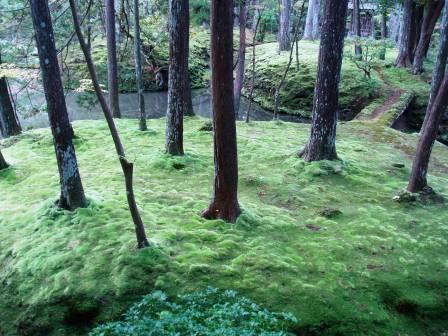
Probably, you would wonder why moss has been thought beautiful. It has been regarded as one of the salient plants to let us feel SABI, the aesthetic term to describe something many Japanese are attracted to. Moss looks beautiful to us because it gives us a chance to see what has been engendered for a much longer period than a life of a human being is. In another expression, we respect and appreciate it because it is thought to be created by the passage of time or something beyond human power and capability.
Below is moss garden seen in one of the great temples in Japan, ginkaku-ji (Silver Temple).

Well, if you visit Saiho-ji, you're required to reserve a couple of months before visiting Saiho-ji. And there you're permitted to see the sights in the garden after making a handwritten copy of one passage in a Buddhistic scripture to give you calmness because it is thought concentrating into writing in a ritual or formal way would offer you a feeling of calmness and detachment.
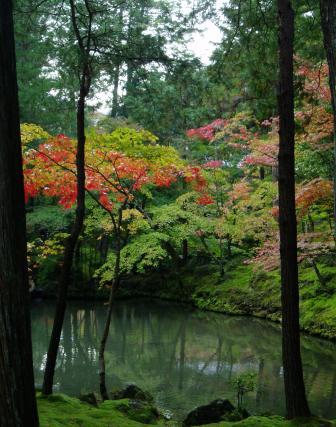
I would recommend you to come to Saiho-ji in November because you will be able to enjoy the contrast of Moss Green with Red Leaves. When I was there, I found I had not seen such a beautiful place. I was driven to keep taking photos of the sights, but I also found my photo skill was not enough and I thought I would buy another camera better in quality enough to enable me to take better ones. Next time I go there, I will take a new camera with me.
3/29/2006
Beautiful Foolishness of Things
Have you heard of "Beautiful Foolishness of Things"? This was a remark of Okakura Tenshin, one of those Japanese who tried to explain Japanese culture after Japan encoutered the West. He condensed something Japanese into the expression. I think it is marvelous.
Can you guess what it means? Anyway, that remark reminded me of the conversation between Smith and Neo in the culminating part of The Matrix: Revolution. Smith saw Neo being beaten but trying to fight, and said, "Why, Mr.Anderson? Why, why, why? Why do you do it? Why, why get up? Why keep fighting? Do you believe you're fighting for something? For more than your survival?"
You may more easily understand the meaning of Okakura's remark if you replace "fighting" with "surviving." This is one of the most difficult questions human beings have ever had. Smith continues to ask,
Can you tell me what it is? Do you even know? Is it freedom or truth? Perhaps peace? Could it be for love? Illusions, Mr. Anderson. Vagaries of perception. Temporary constructs of a feeble human intellect trying desperately to jusitify an existence that is without meaning or purpose! And all of them as artificial as the Matrix itself although only a human mind could invent something as insipid as love. You must be able to see it, Mr. Anderson. You must know it by now. You can't win. It's pointess to keep fighting. Why Mr. Anderson? Why do you persist?
I agree with Smith choosing the word "persist" because I don't know why I try to survive. What answer can you give Smith and me? Few persons know exactly where they are in a etaphysical sense, but some of you can persist in stating "Because I choose to (survive)" like Neo answers there.
Well, what do you think many of you would do in this kind of uncertainty? I think many of them have to try to find what is secure in this world on which to establiish their own lives, so what matters most to them should be whether they can be satisfied or not.
They are mortal and temporal, so you will be nothing as things will be, but so long as you live you want to do something that will satisfy you. In this sense, you are foolish, but don't you think they may look beautiful in cherishing their tiny limited lives? At least, some Japanese think so. This philosophy lies behind Japanese culture, according to Okakura Tenshin.
In Faulknerian expression, "between nothing and grief, I will take grief."
Can you guess what it means? Anyway, that remark reminded me of the conversation between Smith and Neo in the culminating part of The Matrix: Revolution. Smith saw Neo being beaten but trying to fight, and said, "Why, Mr.Anderson? Why, why, why? Why do you do it? Why, why get up? Why keep fighting? Do you believe you're fighting for something? For more than your survival?"
You may more easily understand the meaning of Okakura's remark if you replace "fighting" with "surviving." This is one of the most difficult questions human beings have ever had. Smith continues to ask,
Can you tell me what it is? Do you even know? Is it freedom or truth? Perhaps peace? Could it be for love? Illusions, Mr. Anderson. Vagaries of perception. Temporary constructs of a feeble human intellect trying desperately to jusitify an existence that is without meaning or purpose! And all of them as artificial as the Matrix itself although only a human mind could invent something as insipid as love. You must be able to see it, Mr. Anderson. You must know it by now. You can't win. It's pointess to keep fighting. Why Mr. Anderson? Why do you persist?
I agree with Smith choosing the word "persist" because I don't know why I try to survive. What answer can you give Smith and me? Few persons know exactly where they are in a etaphysical sense, but some of you can persist in stating "Because I choose to (survive)" like Neo answers there.
Well, what do you think many of you would do in this kind of uncertainty? I think many of them have to try to find what is secure in this world on which to establiish their own lives, so what matters most to them should be whether they can be satisfied or not.
They are mortal and temporal, so you will be nothing as things will be, but so long as you live you want to do something that will satisfy you. In this sense, you are foolish, but don't you think they may look beautiful in cherishing their tiny limited lives? At least, some Japanese think so. This philosophy lies behind Japanese culture, according to Okakura Tenshin.
In Faulknerian expression, "between nothing and grief, I will take grief."
2/28/2006
Siva's View 4: Buddhism
Buddhism has been regarded as one of the major religions in Japan, but I don't think it has played the same roles as Christianity in the West and Islamism in the Middle East.
It was thought to flow into Japan through Korea in the midst of the 6th century, but it didn't have a definite form or doctrine to cling to, so the people were just attracted by magnificence of Buddhistic statues, which made them believe it had a supernatural power to ask for help.
More important, such splendidness, as you might call ostensiveness, was utilized to unite the small communities into Japan in the 7th century. Therefore, so many huge temples and statues were built in the Nara and Heian periods (710-about 1200).
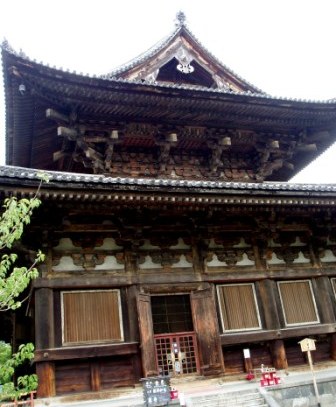
One of the big examples is in the photo. The building is named "Daikodo" in "Todai-ji" in Kyoto. Can you see the small door in the big door? The small one is for persons. The big one is for the 12 huge statues who live inside. I hope you will have a chance to appreciate each of them.
Go to What is Buddhahood?
1/27/2006
Siva's View 3: the Birth of Japan
No preliminary analysis has made it clear where the original Japanese people came from, so you have to be content with the limited information on how Japan began to work as a country. Japan started as a country in the 7th century.
Before that, the island that would be Japan was like the USA in the first half of the seventeenth century. I mean the immigrants came there from different countries and regions, including South Asia and Polynesia. Of course, before they came there, some peoples must have been there, like Eskimos.
From the 4th or 5th century, a powerful people from the Korean peninsula moved to Japan, who tried to survive on tree in Japan because they need them to make iron. Some researchers say that they were so aggressive that they were described as a big snake with eight heads in a myth. Anyway, those Koreans were one of the major peoples in ancient Japan.
As to the dawn of Japan, one of the biggest mysteries was why so many small communities in ancient Japan were integrated into one country without any conflicts. As shown above, there were several peoples, each of them had a community, so it seemed to be difficult for them to have a whole country without any competition, but they did it peacefully.
They needed to be united into a country in the beginning of the 7th century because they were afraid China would assault Ancient Japan consisting of small communities. In fact, China and Kogryo attacked Paekche in the south of the Korean peninsula, and Japan went to help Paekche, but lost the war. Their threat required small communities in Japan to be a whole country.
Before that, the island that would be Japan was like the USA in the first half of the seventeenth century. I mean the immigrants came there from different countries and regions, including South Asia and Polynesia. Of course, before they came there, some peoples must have been there, like Eskimos.
From the 4th or 5th century, a powerful people from the Korean peninsula moved to Japan, who tried to survive on tree in Japan because they need them to make iron. Some researchers say that they were so aggressive that they were described as a big snake with eight heads in a myth. Anyway, those Koreans were one of the major peoples in ancient Japan.
As to the dawn of Japan, one of the biggest mysteries was why so many small communities in ancient Japan were integrated into one country without any conflicts. As shown above, there were several peoples, each of them had a community, so it seemed to be difficult for them to have a whole country without any competition, but they did it peacefully.
They needed to be united into a country in the beginning of the 7th century because they were afraid China would assault Ancient Japan consisting of small communities. In fact, China and Kogryo attacked Paekche in the south of the Korean peninsula, and Japan went to help Paekche, but lost the war. Their threat required small communities in Japan to be a whole country.
Subscribe to:
Posts (Atom)