Why did Japan enter a series of wars, called WWII? According to Siva, the reason was the Japanese overestimation of his own military power. More specifically, his pseudo victory over Russia in the Russo-Japanese War from 1904 to 1905 made him believe he was strong and competent enough to win battles with the Powers.
But that was just a diplomatic victory. Kaneko Kentaro, a Japanese civilian and a friend of Theodore Roosevelt, the President of the United States, asked him to stop the war soon after Japan won just one of the battles in the north of the Liaodong Peninsula.
The battle was the first one of the three battles Russia had expected to have against Japan. But it didn't have enough capabilities and preparations for the three, so it exerted his own full power to win the first one, and asked the President of the USA to stop the war, in order for Japan to hold a dominant position in the meeting with Russia after the war.
Again, it was just a pseudo victory, but the Japanese people was led to think they were strong enough to let them think they wouldn't have to prepare for the WWII and improve any weapons that they had used. In the most parts of the WWII, the Japanese soldiers used the same weapons their fathers created twenty years ago!!
An European researcher, who had been living in Japan till it took up entering the wars and who left for her native country, made a compact and comprehensive remark on how Japan lost the wars to the other countries. She said, "Japanese cannot compare his own powers with others."
Siva also made the same comment. The Japanese leaders didn't. They should have tried to avoid the wars anyway. A war is just a good game for a stronger country. It was not so for Japan. Siva wondered how Japan chose to be involved in the war, and found the cause was the overestimation.

11/26/2005
Siva's View 1: Introduction
My pen-name, Siva, comes from the surname of my favorite author, Siva Ryotaro, who passed away several years ago. He was driven to write so many stories and novels to explore what Japan had been until his encounter with Japan's defeat in the WWII. You should not misunderstand he would try to justify Japan's assault or participation in the war. He was just wondering why Japan chose to go to the series of wars and conflicts from 1920 to 1945 without little prospect of handling the Powers. Japan was so blind. Siva, a tankman during the war, saw the Japanese tanks were so fragile as contrasted to the opponents'. Every one of them was easily crashed by just one shell, while the opponent's ones remained intact. He was surprised to find he was sent to China with such tanks by the Japanese government and thought he would die there. But he didn't die. At the moment he found Japan lost the wars, the big question emerged in his mind why and how Japan entered the wars. He asked himself if Japan had been so unwise again and again. Then, he was 23.
He, after the war, got the job as a newspaperman in a major newspaper publishing company, and was in the charge of cultural matters, including Buddhism and pictures. In 1959, he won the Naoki Prize with the novel, "Owl's Castle," and began to pursue how Japan survived and what persons, especially men, lived and worked in this country. His eyes were not limited to the country, but went to Korea, China, Mongolia, and Tatars, which culturally contributed to what Japan was, and I think "is". And his concern flew to the peoples living near Lake Baikal because they have the same genes as ours according to scientific scrutiniy. Some of the peoples were thought to leave to survive to Japan.
I'm going to describe what Siva discovered in each stage of the Japanese history.
He, after the war, got the job as a newspaperman in a major newspaper publishing company, and was in the charge of cultural matters, including Buddhism and pictures. In 1959, he won the Naoki Prize with the novel, "Owl's Castle," and began to pursue how Japan survived and what persons, especially men, lived and worked in this country. His eyes were not limited to the country, but went to Korea, China, Mongolia, and Tatars, which culturally contributed to what Japan was, and I think "is". And his concern flew to the peoples living near Lake Baikal because they have the same genes as ours according to scientific scrutiniy. Some of the peoples were thought to leave to survive to Japan.
I'm going to describe what Siva discovered in each stage of the Japanese history.
11/13/2005
Hyotei
I went to one of the greatest traditional Japanese restaurants in Kyoto, the oldest city in Japan, named "Hyoutei." I'll describe how I ate marvelous dishes.
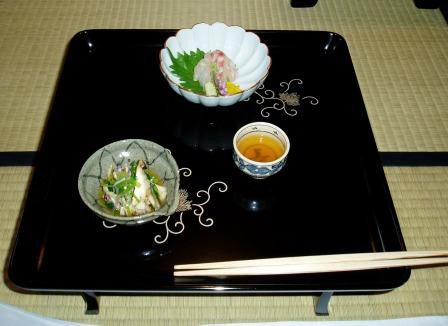
The first dishes were here.
The one over there is raw fish, Tai, one of the valuable fishes in Kyoto, while the one closer to you is a kind of salada with vinegar, full of matsutake, one of the most expensive mushrooms in Japan, cherished for its fragrance.
Well, let me describe what is the most important part in the room. In Japanese tradition, the part below is thought to be the most sacred in the room.
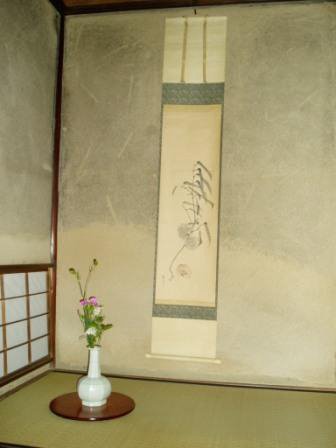

It should be noted that the flowers and the ornament you see in the photo have no relation with any religion. In Japanese tea ceremony, what matters most is tranquilty with which you do everyday-things, like enjoying seeing flowers and reading words, and having meals, and you're expected to do those things very beautifully there. By the time you pass away, you will have taken so many meals; however, you're required to cherish just one meal consisting of several dishes each of which has been elaborately cooked with so much care.
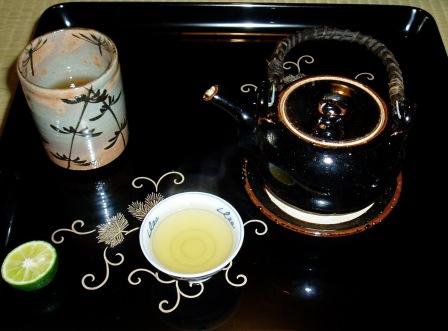 This is "dobin-mushi," which is explained in a book written by an American who is interested in Japanese cuisine, "delicate clear soup made in an individual miniature dobin ... [or] a famous autumn speciality of Kyoto and usually contains matsutake, chicken, mitsuba, and ginnan. The juice of sudachi is squeezed into the dashi, which is drunk from little cups. The other ingredients are fished out chopsticks and eaten. One of the great delicacies of Japan."
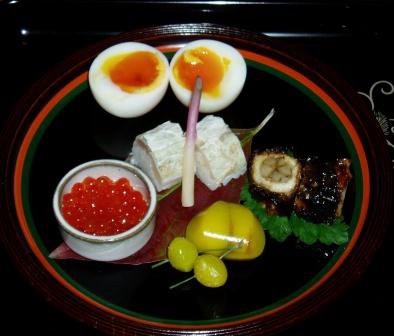
I ate seven dishes there. A meal, consisting of the seven dishes has been regarded here as the greatest and most gorgeous meal in Japan since the twelfth century. The second greatest meal has five dishes, and the third one three dishes. The photo on the left is one of the seven dishes, which comes third. The hard-boiled egg in this restaurant is well-known for its delicateness. I would recommend you to try this if you had a chance to eat there.
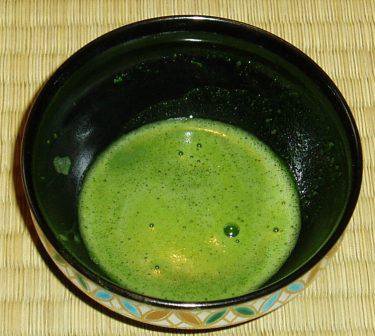
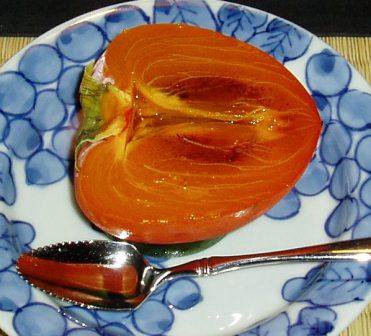
The last dish is the dessert, with which I concluded my special meal in Kyoto, with tea, called "matcha".
10/29/2005
Valuable Mushrooms

In the photo you are seeing the most invalueable mushrooms in Japan, maitake and matsutake, grilled in Japanese paper made from mulberry bark. The former mushroom is famous for its tasting greatest while the latter for its fragrance though non-Japanese may not love them to the extent to which many Japanese cherishe them. Anyway, they are too expensive here!!
9/18/2005
a Japanese Sweet
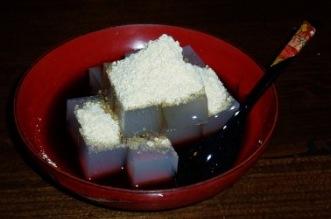
According to some non-Japanese I have ever met, Japanese desserts are not so sweet, not enough to satisfy them. This should be one of them. The semi-transparent cubes are agars made from kudzu, which in itself doesn't have any taste and needs flavor from the white soybean-flour-and sugar powder and the raw-sugar black syrup.
9/16/2005
Who caused Katrina?
Some TV programs and websites have let us know Katrina may have been caused by Japanese Mafias. Was it a joke? Even if it was a joke, I don't like it because I know how disastrous a damage Katrina brought to some of the Southern states where my friends are there.
The TV programs and websites has reported how some of Americans blamed President Bush and FEMA for their slow responses and alleged discrimination. But my rough scrutiny of the websites and the blogs conveying the views of some of you on "who is to blame?" has revealed that the damage would have been much smaller if the New Orleans Mayor Nagin, who looks an African American at a first glance, had followed the instructions prescribed in New Orleans Official website, that is currently unavailable unless you are qualified to see it.
I'm confusing and wondering why some of not only Americans but also the world has blamed the President so bitterly. To me, it's like a political teasing, as adopted by some of the persons who belong to minority groups. My study disclosed how the minorities in the US HAVE incurred so much distress, but it seems to me it is not fair. I'm sure that is not the way my American friends will do it.
The TV programs and websites has reported how some of Americans blamed President Bush and FEMA for their slow responses and alleged discrimination. But my rough scrutiny of the websites and the blogs conveying the views of some of you on "who is to blame?" has revealed that the damage would have been much smaller if the New Orleans Mayor Nagin, who looks an African American at a first glance, had followed the instructions prescribed in New Orleans Official website, that is currently unavailable unless you are qualified to see it.
I'm confusing and wondering why some of not only Americans but also the world has blamed the President so bitterly. To me, it's like a political teasing, as adopted by some of the persons who belong to minority groups. My study disclosed how the minorities in the US HAVE incurred so much distress, but it seems to me it is not fair. I'm sure that is not the way my American friends will do it.
8/23/2005
complicated
Politicians began to prepare for the general election on September 11. There are several political parties here, but each of them doesn't have its own policies. I mean the members in a party have so different opinions and views on the policies Japan is required to handle as to make it difficult for us to choose a political party that we should support.
8/11/2005
China, that looks sly to Japan.
Did you read the article in BBC, which reported the Japanese protest against China's move to get oil gas buried in the exclusive economic zone of Japan, though the place where it began to dig it is within the EEZ of China. We have the rule that an exclusive economic zone should be within 370 km from the mainland of a country. But China stated it is not from the mainland but from the continental shelf to justify siphon the gas there. Moreover, after the Japanese protest, China told Japan to work together. Japan refused its offer because it is buried under the Japanese EEZ, and permitted a Japanese company to get the gas; then, China began to say that Japan was so agressive.
Japan has been avoiding exploring such area because it didn't want any trouble with China. Then, China began to do that. In this kind of case, many of Japanese think China should not do that if it doesn't want any trouble with Japan. But I know this kind of thinking looks a little bit abstinent to some of you. Do you think the Chinese move can be OK?
Japan has been avoiding exploring such area because it didn't want any trouble with China. Then, China began to do that. In this kind of case, many of Japanese think China should not do that if it doesn't want any trouble with Japan. But I know this kind of thinking looks a little bit abstinent to some of you. Do you think the Chinese move can be OK?
8/10/2005
Good!!
Here has been noisy because two days ago the Prime Minister Koizumi Junichiro dissolved the Diet after the bill of privatizing public postal services, one of his campaign promises, was voted down in the House of Councilors, due to some of the Liberal Democrats rebelling against the President of the Government party.
This seemed to be good to Japan because they will be likely to have an opportunity to exclude those representatives from the Diet, who were protecting the vested rights that they and their supporters had had, and tried to stop the reformations needed to update the Japanese governmental systems. One of the biggest troubles that Japan has had should be that Japan hasn't adjusted itself to the present era that began in 1989 after the end of the Cold War era. The governmental systems has been working in the same way as in the Cold War era, when Japanese economy worked well in the US-oriented world.
Anyway, it was good. What matters most is how many younger persons will vote in the general election on September, 11.
This seemed to be good to Japan because they will be likely to have an opportunity to exclude those representatives from the Diet, who were protecting the vested rights that they and their supporters had had, and tried to stop the reformations needed to update the Japanese governmental systems. One of the biggest troubles that Japan has had should be that Japan hasn't adjusted itself to the present era that began in 1989 after the end of the Cold War era. The governmental systems has been working in the same way as in the Cold War era, when Japanese economy worked well in the US-oriented world.
Anyway, it was good. What matters most is how many younger persons will vote in the general election on September, 11.
8/06/2005
Hiroshima's Mayor's Speech
The Mayor of Hiroshima City made a good speech this morning, saying no countries without nuclear weapons seem to have any right to speak in the international meetings, IAEA, Six countries talk, and the Security Council. I agree with him.
7/31/2005
My Kyoto Memory
 I went to Kyoto with my friends last week. There are so many sights to see, but I wanted to watch most the temple of Manshu-in(曼殊院), located in the north east part of Kyoto. Its name comes from a Bodhisattva in Sanskrit, but it is not a Buddhistic temple in nature mainly because in the Edo Era many of the imperial Princes were required to live there as Buddhistic priests lest they should participate in the politics.
The prince who built this was Ryo-sho-Ho Sin-no (良尚法親王: 1622-1693), whose father, Tomohito Sin-no, was frequently invited to tea ceremonies hosted by Toyotomi Hideyoshi, the person in power during the second half of the Aduchi Momoyama Era, who tried to be a court noble to keep his dynasty secure. They came to have a close relation. Probably, that's why Tokugawa Ieyasu, the person in power during the Edo Era following Aduchi-Momoyama Era, should have disliked and tried to exclude the court nobles.
I got interested in Manshu-in because I saw some of the beautiful pictures of Manshu-in in some books, websites, and magazines. Then I read some of the articles about Manshu-in written by my favorite author, Siva Ryotaro, who stopped by Manshu-in to see the garden every time he visited Kyoto, and I was itching to see the garden of Mansu-in. Here are some features of the garden below, he mentioned.
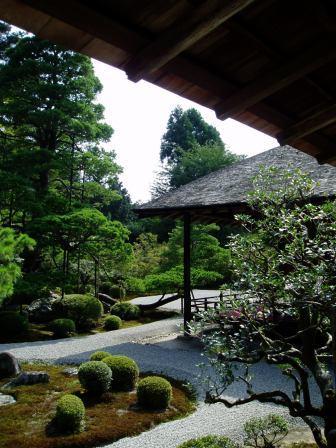
- Traditionally, a garden can be looked upon as a picture or drawing in Japan. You can say the garden is the center of the temple. I mean they designed houses for the places to enjoy watching the gardens. In most cases, they describe seceneries seen in forests deep in mountains because they need them to see their survival game in the present world in perspective. As I should add, rich persons in Japan are expected to have such gardens with houses. The same is true of Manshu-in. There, the Imperial princes lived. They tried to enjoy that.
- Can you see the white sand in the picture on the left? It is the river running. This kind of drawing is called "Kare-San-sui." Can you see the corridor with handrails, running along the sand river? You're required to think the passage be part of a roofed pleasure boat with a tatami floor and shoji, on which Japanese enjoy watching good sights sometimes drinking. You have to walk the corridor, but in your imagination you are in the boat floating on the river to a place deep in the mountains, and you may find yourself in the Pure Land, if you immerse yourself in the drawing.
7/13/2005
No Justice
Japan is going to be isolated because it is trying to get back the abductees from North Korea in the meeting of the six countries, the US, Russia, China, South Korea, North Korea and Japan. You know, North Korea was a communist country, so it tried to communize and absorb South Korea into One Korea. Then, it abducted more than 100 Japanese to use them as secret agents for North Korea. It was a terrible crime or terror. You should imagine you're suddenly kidnapped and sent to North Korea, and you are forced to live there and to be trained as a secret agent. They have never seen their parents for more than twenty five years. Don't you think it's bitter? But the other four countries, the US, Russia, China, and South Korea, have decided to ignore the evil crime. I'm very disappointed because the problem of on which side is justice is going to be handled by whether you have nuclear weapon or not. Rather, it seems to me, a Japanese, that they are going to isolate Japan as they did to Japan in the first half of the 20th century. Do you know what it means? Isolation is the first stage toward attributing complicated and unresolved matters to the country isolated.
7/02/2005
A remark on a report by a Chinese
Today, I found and read a report written by a Chinese who were interested in Japanese Nobel Prize Winners in Literature, came to Japan to study some of them for three years and came to hate Japanese because he felt discriminated and underestimated there. Now he is back in China, leading some group protesting against Japan. In the report, he explained how he came to dislike Japanese. He attributed his hatred toward Japan not to the brainstorming imposed on the Chinese but to his encounter with Japanese scorn for Chinese during his stay in Japan. He even found the sign "No Chinese" in front of a bathhouse in Japan. According to him, more than 90 percent of those Chinese who come and stay in Japan should become anti-Japanese, even though he loved Japanese culture before coming to Japan.
The report, he says, is the first chapter of the six. The other chapters, not published yet, are designed to describe 1) Japanese are ignorant of China and Chinese, 2) The good relationship among the East Asian countries (China, Korea, and Japan) has been destroyed by Japanese ally with the Western countries, 3) Japan is preoccupied with the illusion it has been superior to China, 4) China is requiring Japan not to give China much money but to show something sincere, and 5) Japan should ally with China to create a peaceful relation among China, Korea, and Japan, and to change the power balance in the world.
I love to read all of them. I cannot wait. The five topic sentences are attractive enough to drive me make small comments on them.
Concerning 1 and 3, I cannot say he isn't right. Some of us have categorized China as a developing country, based on the western standard of "progress," and we've been forced to update our concept of China. Now many of us recognize they don't know about China as well as Korea. But I would say this is vice versa. They don't know well about us, either.
As to the sign of "No Chinese," I'm not sure exactly why, but many of us guess some conflicts got the owner to hang out the sign. I would say they should have been caused by some cultural differences in manner, especially in distinction between public and private spheres. Bathhouses are both public and private places in Japan. There, you're required to keep some rules in your minds. I mean some Chinese would violate some of the rules common to many of Japanese. The owner, I would conclude, should have tried to preclude the bad-manner reputation because s/he was afraid Japanese customers would not come to the bathhouse.
It would be hard for me to explain and define all of the deeds that may look tacky to most Japanese. You know, customs and etiquettes in many cases refuse logical explanation. Japan has been an isolated island country since its birth, so it has engendered some cultural manners that may look absurd or illogical to you. And let me tell the Chinese it would take much more time to be familiar with a culture alien to you. Some say your three year stay would make your host country look so bitter. I have studied in a graduate school in US, but I would not like the US unless I had got two kind American friends there. The impression of a host foreign country, I would say, depends to some degree upon your company there in the first stage of your conformity to the country.
Additionally, Chinese are notorious for two reasons. First, I hear that many of Chinese don't adjust themselves to foregin environments even if they have to settle there. More important, we're scared of the Chinese because we know they come to Japan to earn just money, even if they dislike and hate Japan, and then commit crimes. Of course, it may be just rumors. But if your countrymen are assaulted by some persons belonging to one single group, some of us should be so scared of the whole group as to make a rule to preclude them. Anyway, we need to talk for mutual understanding.
His assertions in 2 and 5 sound quite interesting and right, but this is a matter of ours, as was in the early stage of the 20th century. One of the Japanese intelligensia proposed then Japan should get out of the East Asia to survive in the World revolving on the Imperialism. We don't think the judgment was the most appropriate, but we don't criticize it as the most inappropriate. Let us think about it, anyway.
The statement in 4 concerns historical matters. We're wondering why some of the Chinese like to criticize Japan referring to what it did in the past in spite of their recognition that Japan was not quite cruel and evil. The late Chinese leaders, like Deng Xiaoping, Chiang Kaishek, and Mao Tse-tung, suggested that Japan should not be blamed in their writings. I cannot trust those Chinese who know they should not criticize Japan but have criticized it for their own purposes.
The report, he says, is the first chapter of the six. The other chapters, not published yet, are designed to describe 1) Japanese are ignorant of China and Chinese, 2) The good relationship among the East Asian countries (China, Korea, and Japan) has been destroyed by Japanese ally with the Western countries, 3) Japan is preoccupied with the illusion it has been superior to China, 4) China is requiring Japan not to give China much money but to show something sincere, and 5) Japan should ally with China to create a peaceful relation among China, Korea, and Japan, and to change the power balance in the world.
I love to read all of them. I cannot wait. The five topic sentences are attractive enough to drive me make small comments on them.
Concerning 1 and 3, I cannot say he isn't right. Some of us have categorized China as a developing country, based on the western standard of "progress," and we've been forced to update our concept of China. Now many of us recognize they don't know about China as well as Korea. But I would say this is vice versa. They don't know well about us, either.
As to the sign of "No Chinese," I'm not sure exactly why, but many of us guess some conflicts got the owner to hang out the sign. I would say they should have been caused by some cultural differences in manner, especially in distinction between public and private spheres. Bathhouses are both public and private places in Japan. There, you're required to keep some rules in your minds. I mean some Chinese would violate some of the rules common to many of Japanese. The owner, I would conclude, should have tried to preclude the bad-manner reputation because s/he was afraid Japanese customers would not come to the bathhouse.
It would be hard for me to explain and define all of the deeds that may look tacky to most Japanese. You know, customs and etiquettes in many cases refuse logical explanation. Japan has been an isolated island country since its birth, so it has engendered some cultural manners that may look absurd or illogical to you. And let me tell the Chinese it would take much more time to be familiar with a culture alien to you. Some say your three year stay would make your host country look so bitter. I have studied in a graduate school in US, but I would not like the US unless I had got two kind American friends there. The impression of a host foreign country, I would say, depends to some degree upon your company there in the first stage of your conformity to the country.
Additionally, Chinese are notorious for two reasons. First, I hear that many of Chinese don't adjust themselves to foregin environments even if they have to settle there. More important, we're scared of the Chinese because we know they come to Japan to earn just money, even if they dislike and hate Japan, and then commit crimes. Of course, it may be just rumors. But if your countrymen are assaulted by some persons belonging to one single group, some of us should be so scared of the whole group as to make a rule to preclude them. Anyway, we need to talk for mutual understanding.
His assertions in 2 and 5 sound quite interesting and right, but this is a matter of ours, as was in the early stage of the 20th century. One of the Japanese intelligensia proposed then Japan should get out of the East Asia to survive in the World revolving on the Imperialism. We don't think the judgment was the most appropriate, but we don't criticize it as the most inappropriate. Let us think about it, anyway.
The statement in 4 concerns historical matters. We're wondering why some of the Chinese like to criticize Japan referring to what it did in the past in spite of their recognition that Japan was not quite cruel and evil. The late Chinese leaders, like Deng Xiaoping, Chiang Kaishek, and Mao Tse-tung, suggested that Japan should not be blamed in their writings. I cannot trust those Chinese who know they should not criticize Japan but have criticized it for their own purposes.
6/19/2005
remaining or forged?
Did you see the pictures? I don't understand why they need to let their children inherit such hatred against Japan from the children's great grandparents? I partly understand they cannot forgive those who killed their parents and relatives, but I don't think it good to teach them such hostility in public school. I would say the antipathy has not remained but been forged in their minds to create their own nationalism that their great grandparents really wanted to be against Japan and other imperialistic countries 100 years ago. If they want to make their occupation of Liancourt Rocks secure, they only have to leave the case to the World court, as suggested by the Japanese government. I'm afraid now some of the Korean children will offend and assault the innocent great grandchildren of the Japanese who colonized Korea 100 years ago, and that the South Korean government has no intention to be friendly with Japan. I would say they need it as the only available virtual enemy to encourage their people to work and study harder to get the country to be strong enough to assuage their anger and anguish against themselves in the past, who did nothing for their country. I would also say I could share those feelings, though.
You could read this to learn that the US supported South Korea to create the hostility to some degrees after the WWII.
You could read this to learn that the US supported South Korea to create the hostility to some degrees after the WWII.
6/01/2005
Antiwar Pact
Japan has been trying to draft new laws in some of the international committees like NPT, that will bring about a peaceful society without any war, for it knows the stark fact that a war works as a game like soccer, baseball, just to decide which wins in a battle; so it does not help to judge which is right over a matter. Therefore, in the NPT meeting, Japan tried to make articles that will disarm some countries(China and US) and will prevent others(the countries in the Middle East, and North Korea) from using nuclear power strategically. But they refused it, for the proposition seems to them absurd in this real world. The NPT has been useless already. Japan has to get the seat of the permanent members of the United Nation Security Council to accomplish the purpose that it tried to attain in drafting the second article in the Paris antiwar pact in 1928.
5/29/2005
The End of the Spring
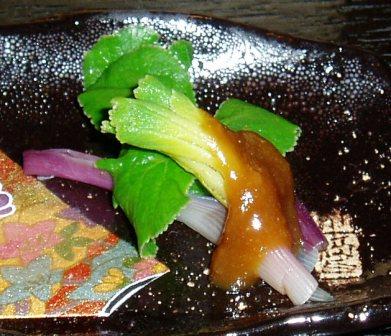 I went to Yuto, one of the authentic Japanese traditional restaurants, where I ate hamabohfu in the picture, a wild plant which grows on the seacoast and creates a wind blowing in your body after you eat it. My experience has revealed wild plants have something special that cannot be found in vegetables grown in the fields partly because wild ones have survived by its own survival power in the environment, without any recourse to human care including organic fertilizers.
 Hamaboufu heralds the end of the spring and the beginning of the season in June, in which it rains very often.
5/27/2005
Anti Binary Oppositions
A Japanese was killed in Iraq, who was employed as a bodyguard or something in a company. We will never forget two innocent Japanese have been killed in Iraq. Japan may have looked offensive to some in supporting the USA in the war and sending the army there, but we're adamant that the Japanese army was sent there to keep some area ivolved peaceful. I mean Japan was trying to play a different role in Iraq from the ones any other country did. You will see how many of Japanese dislike binary oppositions after studying about Japan. Our detachment from the oppisitions, which may seem to be vague, would be found in the history of Japan except in the first half of the twentieth century. Anyway, we will never forget those killings while I know some would think Japan was against them.
5/01/2005
Tragedy
Last Monday a tragedy happened in Japan. A train got derailed and crashed against a big apartment built along the rails, and about 100 persons passed over so far. Each of them had their own lives, which they expected to be continuing more....
A lot of stories have been narrated here concerning the persons who cannot tell us any longer about themselves and anything that they were going to do on that day and the days to follow. One of them was a girl, who lost her mother several years ago and had played the role of the mother in her family. She encountered the accident on the way to her first overseas trip to Korea since her mother's death.
An accident takes place anytime anywhere. Seeing that disaster, a Japanese is led to think he or she might have incurred that tragedy, while some of us thinks it was caused by mistakes of the motorman or the company that gave him a tight schedule or much pressure. I belong to the former.
I was most depressed when I heard a saying of a middle-aged man who was bereaved of his wife. He said, "I don't know why my wife encountered the accident because I didn't think she had done what God dislikes. We have been working diligently without committing any harmful things, ... I don't know why God gave it to my wife."
Some facts are difficult to overcome or accept. What should you do when you encounter such tragedies like the deaths of the persons you cherish most? Can you give me or him an answer?
A lot of stories have been narrated here concerning the persons who cannot tell us any longer about themselves and anything that they were going to do on that day and the days to follow. One of them was a girl, who lost her mother several years ago and had played the role of the mother in her family. She encountered the accident on the way to her first overseas trip to Korea since her mother's death.
An accident takes place anytime anywhere. Seeing that disaster, a Japanese is led to think he or she might have incurred that tragedy, while some of us thinks it was caused by mistakes of the motorman or the company that gave him a tight schedule or much pressure. I belong to the former.
I was most depressed when I heard a saying of a middle-aged man who was bereaved of his wife. He said, "I don't know why my wife encountered the accident because I didn't think she had done what God dislikes. We have been working diligently without committing any harmful things, ... I don't know why God gave it to my wife."
Some facts are difficult to overcome or accept. What should you do when you encounter such tragedies like the deaths of the persons you cherish most? Can you give me or him an answer?
4/28/2005
Mistake
I have to be sorry because I made a mistake. I found the mistake in one of the articles I posted here, about the unavoidable four pains in Buddhistic view. A book on Buddhism, I have finished reading recently, illustrates the true meaning of the pains, "duhka" in the original language. Some Buddhistic books written in about 100-200 BC showed the pains referred to the unavoidable pains. But the book reveals "duhka" means the situation in which you have to think more or in which you are so ignorant that you see a phenomenon in terms of binary oppositions. Sorry.
4/24/2005
Japanese textbooks
Etymologically, "history" means "one who sees or knows," and, in Latin or Greek, "learning by inquiry." That is, "history" is a subject for those who are not content with what they have learned, and think they have to know more. Let me tell you Japanese people has got a biggest information about what happened around Japan from 1900 to 1945 because they've been required to face up to what their grandfathers did during the war, and have had to ask themselves, "why has Japan been blamed for what it did during the period?"
We know invasion is so bad, and if our grandfathers did it to the Koreans and Chineses we ought to feel sorry for that, as our grandfathers would do so. But we cannot help starting with "but...". Because our survey on many records and reports about the war, available to us now, has compelled us to wonder why only Japan has been criticized so bitterly as to be called the evilest country that had ever existed in the history of the Earth. Japan was bad, indeed, to colonize Korea and assault China, and to make the surprise attack on the American army at the Pearl Harbor. But let me ask you if other countries including China did not do anything harmful or cheating during that period. Our survey reveals the war was not so simple. The situation was so complicated. The textbooks to be adopted in Japanese school, called nationalistic in some medias in the world, referred to what other countries did during the war, to describe the world as it was, so I don't think it is trying to legitimate what Japan did during the war. It just wanted to give children as accurate an description of the world in the first half of the 20th century as possible.
We know invasion is so bad, and if our grandfathers did it to the Koreans and Chineses we ought to feel sorry for that, as our grandfathers would do so. But we cannot help starting with "but...". Because our survey on many records and reports about the war, available to us now, has compelled us to wonder why only Japan has been criticized so bitterly as to be called the evilest country that had ever existed in the history of the Earth. Japan was bad, indeed, to colonize Korea and assault China, and to make the surprise attack on the American army at the Pearl Harbor. But let me ask you if other countries including China did not do anything harmful or cheating during that period. Our survey reveals the war was not so simple. The situation was so complicated. The textbooks to be adopted in Japanese school, called nationalistic in some medias in the world, referred to what other countries did during the war, to describe the world as it was, so I don't think it is trying to legitimate what Japan did during the war. It just wanted to give children as accurate an description of the world in the first half of the 20th century as possible.
Subscribe to:
Posts (Atom)