Since May 3rd, 1947, Japan has had the current constitution, which might change to activate the Japan Army under the present Prime Minister regime. Recently, there has been talk about whether it should be revised. Most crucial in the talk seems to be the ninth article: Japan does not have any force effective to handle international conflicts.
The problem is on how to intepret the international conflicts, or, more directly, if the purpose of self-defense will be categorized into international conflict. This is a gray zone susceptible to some interpretations. This room was the cause of our WWII, concluded by some of us. The room gives persons in power the choice to interpret and lets them run.
It is nonsense to try to choose one of the two views: the first that war or violence cannot work as a way to solve conflicts among nations but to conclude and the second we need to have the capacity to protect our country and the world peace from countries that will try to handle matters with power. Because both of them are right. History tells us wars have killed guilty and innocent persons indiscriminately and good and righteous persons are not always superior to evil persons in power.
The two views can remain intact in the current ninth article; therefore, I conclude we should not change the constitution. The problem is not the constitution but how we can use it, so we must be deliberate when electing the representatives among whom the prime minister will be selected. More important, any person, however diligent and deliberate they are, can make mistakes in many cases, so you have to realize each of you should be responsible for the decision our leader you have elected has made.
Showing posts with label Japan. Show all posts
Showing posts with label Japan. Show all posts
5/03/2007

4/21/2006
Moss Temple
If you are planning to come to Japan, I'll recommend you to visit Saiho-ji in Kyoto. You will see the sights of MOSS that many of Japanese think most beautiful.
Well, if you visit Saiho-ji, you're required to reserve a couple of months before visiting Saiho-ji. And there you're permitted to see the sights in the garden after making a handwritten copy of one passage in a Buddhistic scripture to give you calmness because it is thought concentrating into writing in a ritual or formal way would offer you a feeling of calmness and detachment.
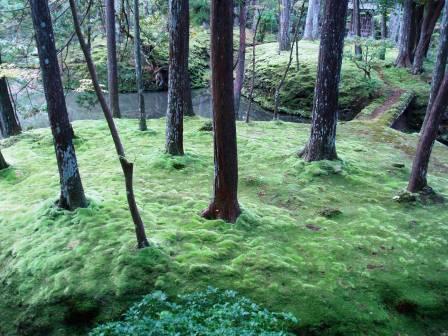
Probably, you would wonder why moss has been thought beautiful. It has been regarded as one of the salient plants to let us feel SABI, the aesthetic term to describe something many Japanese are attracted to. Moss looks beautiful to us because it gives us a chance to see what has been engendered for a much longer period than a life of a human being is. In another expression, we respect and appreciate it because it is thought to be created by the passage of time or something beyond human power and capability.
Below is moss garden seen in one of the great temples in Japan, ginkaku-ji (Silver Temple).

Well, if you visit Saiho-ji, you're required to reserve a couple of months before visiting Saiho-ji. And there you're permitted to see the sights in the garden after making a handwritten copy of one passage in a Buddhistic scripture to give you calmness because it is thought concentrating into writing in a ritual or formal way would offer you a feeling of calmness and detachment.
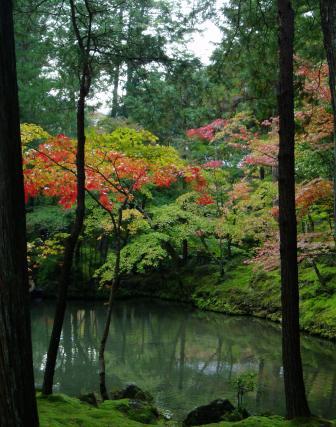
I would recommend you to come to Saiho-ji in November because you will be able to enjoy the contrast of Moss Green with Red Leaves. When I was there, I found I had not seen such a beautiful place. I was driven to keep taking photos of the sights, but I also found my photo skill was not enough and I thought I would buy another camera better in quality enough to enable me to take better ones. Next time I go there, I will take a new camera with me.
3/29/2006
Beautiful Foolishness of Things
Have you heard of "Beautiful Foolishness of Things"? This was a remark of Okakura Tenshin, one of those Japanese who tried to explain Japanese culture after Japan encoutered the West. He condensed something Japanese into the expression. I think it is marvelous.
Can you guess what it means? Anyway, that remark reminded me of the conversation between Smith and Neo in the culminating part of The Matrix: Revolution. Smith saw Neo being beaten but trying to fight, and said, "Why, Mr.Anderson? Why, why, why? Why do you do it? Why, why get up? Why keep fighting? Do you believe you're fighting for something? For more than your survival?"
You may more easily understand the meaning of Okakura's remark if you replace "fighting" with "surviving." This is one of the most difficult questions human beings have ever had. Smith continues to ask,
Can you tell me what it is? Do you even know? Is it freedom or truth? Perhaps peace? Could it be for love? Illusions, Mr. Anderson. Vagaries of perception. Temporary constructs of a feeble human intellect trying desperately to jusitify an existence that is without meaning or purpose! And all of them as artificial as the Matrix itself although only a human mind could invent something as insipid as love. You must be able to see it, Mr. Anderson. You must know it by now. You can't win. It's pointess to keep fighting. Why Mr. Anderson? Why do you persist?
I agree with Smith choosing the word "persist" because I don't know why I try to survive. What answer can you give Smith and me? Few persons know exactly where they are in a etaphysical sense, but some of you can persist in stating "Because I choose to (survive)" like Neo answers there.
Well, what do you think many of you would do in this kind of uncertainty? I think many of them have to try to find what is secure in this world on which to establiish their own lives, so what matters most to them should be whether they can be satisfied or not.
They are mortal and temporal, so you will be nothing as things will be, but so long as you live you want to do something that will satisfy you. In this sense, you are foolish, but don't you think they may look beautiful in cherishing their tiny limited lives? At least, some Japanese think so. This philosophy lies behind Japanese culture, according to Okakura Tenshin.
In Faulknerian expression, "between nothing and grief, I will take grief."
2/28/2006
Siva's View 4: Buddhism
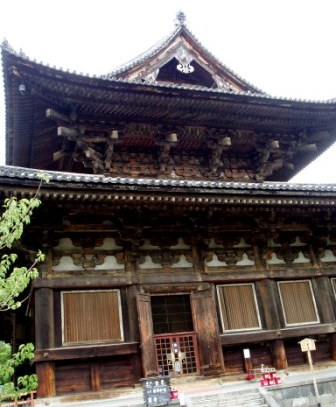
Buddhism has been regarded as one of the major religions in Japan, but I don't think it has played the same roles as Christianity in the West and Islamism in the Middle East.
It was thought to flow into Japan through Korea in the midst of the 6th century, but it didn't have a definite form or doctrine to cling to, so the people were just attracted by magnificence of Buddhistic statues, which made them believe it had a supernatural power to ask for help.
More important, such splendidness, as you might call ostensiveness, was utilized to unite the small communities into Japan in the 7th century. Therefore, so many huge temples and statues were built in the Nara and Heian periods (710-about 1200).
One of the big examples is in the photo. The building is named "Daikodo" in "Todai-ji" in Kyoto. Can you see the small door in the big door? The small one is for persons. The big one is for the 12 huge statues who live inside. I hope you will have a chance to appreciate each of them.
Go to What is Buddhahood?
1/27/2006
Siva's View 3: the Birth of Japan
No preliminary analysis has made it clear where the original Japanese people came from, so you have to be content with the limited information on how Japan began to work as a country. Japan started as a country in the 7th century.
Before that, the island that would be Japan was like the USA in the first half of the seventeenth century. I mean the immigrants came there from different countries and regions, including South Asia and Polynesia. Of course, before they came there, some peoples must have been there, like Eskimos.
From the 4th or 5th century, a powerful people from the Korean peninsula moved to Japan, who tried to survive on tree in Japan because they need them to make iron. Some researchers say that they were so aggressive that they were described as a big snake with eight heads in a myth. Anyway, those Koreans were one of the major peoples in ancient Japan.
As to the dawn of Japan, one of the biggest mysteries was why so many small communities in ancient Japan were integrated into one country without any conflicts. As shown above, there were several peoples, each of them had a community, so it seemed to be difficult for them to have a whole country without any competition, but they did it peacefully.
They needed to be united into a country in the beginning of the 7th century because they were afraid China would assault Ancient Japan consisting of small communities. In fact, China and Kogryo attacked Paekche in the south of the Korean peninsula, and Japan went to help Paekche, but lost the war. Their threat required small communities in Japan to be a whole country.
11/26/2005
Siva's View 1: Introduction
My pen-name, Siva, comes from the surname of my favorite author, Siva Ryotaro, who passed away several years ago. He was driven to write so many stories and novels to explore what Japan had been until his encounter with Japan's defeat in the WWII. You should not misunderstand he would try to justify Japan's assault or participation in the war. He was just wondering why Japan chose to go to the series of wars and conflicts from 1920 to 1945 without little prospect of handling the Powers. Japan was so blind. Siva, a tankman during the war, saw the Japanese tanks were so fragile as contrasted to the opponents'. Every one of them was easily crashed by just one shell, while the opponent's ones remained intact. He was surprised to find he was sent to China with such tanks by the Japanese government and thought he would die there. But he didn't die. At the moment he found Japan lost the wars, the big question emerged in his mind why and how Japan entered the wars. He asked himself if Japan had been so unwise again and again. Then, he was 23.
He, after the war, got the job as a newspaperman in a major newspaper publishing company, and was in the charge of cultural matters, including Buddhism and pictures. In 1959, he won the Naoki Prize with the novel, "Owl's Castle," and began to pursue how Japan survived and what persons, especially men, lived and worked in this country. His eyes were not limited to the country, but went to Korea, China, Mongolia, and Tatars, which culturally contributed to what Japan was, and I think "is". And his concern flew to the peoples living near Lake Baikal because they have the same genes as ours according to scientific scrutiniy. Some of the peoples were thought to leave to survive to Japan.
I'm going to describe what Siva discovered in each stage of the Japanese history.
11/13/2005
Hyotei
I went to one of the greatest traditional Japanese restaurants in Kyoto, the oldest city in Japan, named "Hyoutei." I'll describe how I ate marvelous dishes.
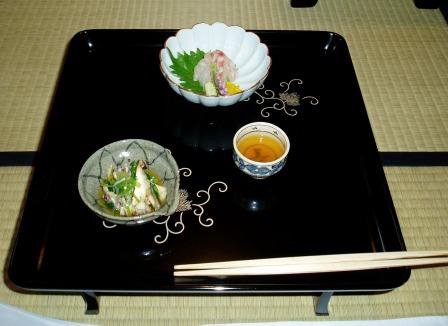
The first dishes were here.
The one over there is raw fish, Tai, one of the valuable fishes in Kyoto, while the one closer to you is a kind of salada with vinegar, full of matsutake, one of the most expensive mushrooms in Japan, cherished for its fragrance.
Well, let me describe what is the most important part in the room. In Japanese tradition, the part below is thought to be the most sacred in the room.
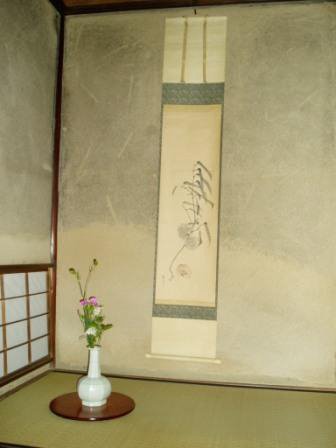

It should be noted that the flowers and the ornament you see in the photo have no relation with any religion. In Japanese tea ceremony, what matters most is tranquilty with which you do everyday-things, like enjoying seeing flowers and reading words, and having meals, and you're expected to do those things very beautifully there. By the time you pass away, you will have taken so many meals; however, you're required to cherish just one meal consisting of several dishes each of which has been elaborately cooked with so much care.
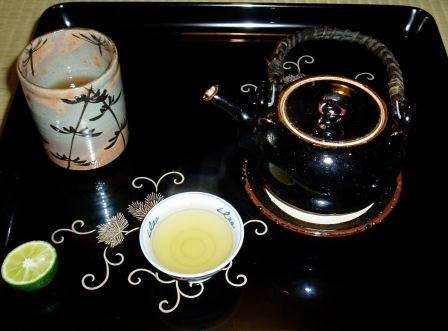 This is "dobin-mushi," which is explained in a book written by an American who is interested in Japanese cuisine, "delicate clear soup made in an individual miniature dobin ... [or] a famous autumn speciality of Kyoto and usually contains matsutake, chicken, mitsuba, and ginnan. The juice of sudachi is squeezed into the dashi, which is drunk from little cups. The other ingredients are fished out chopsticks and eaten. One of the great delicacies of Japan."
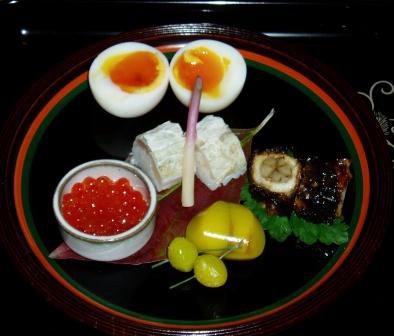
I ate seven dishes there. A meal, consisting of the seven dishes has been regarded here as the greatest and most gorgeous meal in Japan since the twelfth century. The second greatest meal has five dishes, and the third one three dishes. The photo on the left is one of the seven dishes, which comes third. The hard-boiled egg in this restaurant is well-known for its delicateness. I would recommend you to try this if you had a chance to eat there.
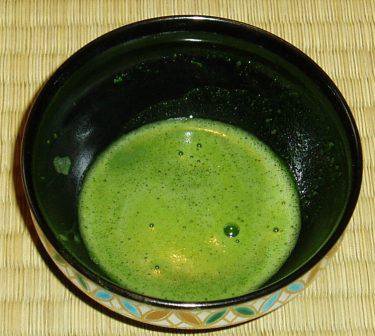
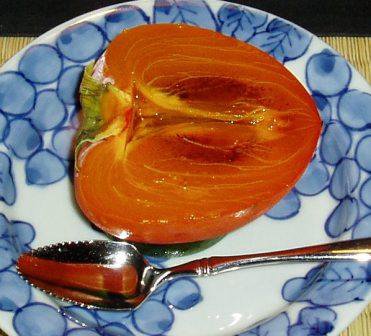
The last dish is the dessert, with which I concluded my special meal in Kyoto, with tea, called "matcha".
10/29/2005
Valuable Mushrooms

In the photo you are seeing the most invalueable mushrooms in Japan, maitake and matsutake, grilled in Japanese paper made from mulberry bark. The former mushroom is famous for its tasting greatest while the latter for its fragrance though non-Japanese may not love them to the extent to which many Japanese cherishe them. Anyway, they are too expensive here!!
9/18/2005
a Japanese Sweet
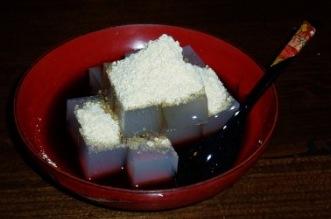
According to some non-Japanese I have ever met, Japanese desserts are not so sweet, not enough to satisfy them. This should be one of them. The semi-transparent cubes are agars made from kudzu, which in itself doesn't have any taste and needs flavor from the white soybean-flour-and sugar powder and the raw-sugar black syrup.
8/23/2005
complicated
Politicians began to prepare for the general election on September 11. There are several political parties here, but each of them doesn't have its own policies. I mean the members in a party have so different opinions and views on the policies Japan is required to handle as to make it difficult for us to choose a political party that we should support.
8/10/2005
Good!!
Here has been noisy because two days ago the Prime Minister Koizumi Junichiro dissolved the Diet after the bill of privatizing public postal services, one of his campaign promises, was voted down in the House of Councilors, due to some of the Liberal Democrats rebelling against the President of the Government party.
This seemed to be good to Japan because they will be likely to have an opportunity to exclude those representatives from the Diet, who were protecting the vested rights that they and their supporters had had, and tried to stop the reformations needed to update the Japanese governmental systems. One of the biggest troubles that Japan has had should be that Japan hasn't adjusted itself to the present era that began in 1989 after the end of the Cold War era. The governmental systems has been working in the same way as in the Cold War era, when Japanese economy worked well in the US-oriented world.
Anyway, it was good. What matters most is how many younger persons will vote in the general election on September, 11.
8/06/2005
Hiroshima's Mayor's Speech
The Mayor of Hiroshima City made a good speech this morning, saying no countries without nuclear weapons seem to have any right to speak in the international meetings, IAEA, Six countries talk, and the Security Council. I agree with him.
7/31/2005
My Kyoto Memory
 I went to Kyoto with my friends last week. There are so many sights to see, but I wanted to watch most the temple of Manshu-in(曼殊院), located in the north east part of Kyoto. Its name comes from a Bodhisattva in Sanskrit, but it is not a Buddhistic temple in nature mainly because in the Edo Era many of the imperial Princes were required to live there as Buddhistic priests lest they should participate in the politics.
The prince who built this was Ryo-sho-Ho Sin-no (良尚法親王: 1622-1693), whose father, Tomohito Sin-no, was frequently invited to tea ceremonies hosted by Toyotomi Hideyoshi, the person in power during the second half of the Aduchi Momoyama Era, who tried to be a court noble to keep his dynasty secure. They came to have a close relation. Probably, that's why Tokugawa Ieyasu, the person in power during the Edo Era following Aduchi-Momoyama Era, should have disliked and tried to exclude the court nobles.
I got interested in Manshu-in because I saw some of the beautiful pictures of Manshu-in in some books, websites, and magazines. Then I read some of the articles about Manshu-in written by my favorite author, Siva Ryotaro, who stopped by Manshu-in to see the garden every time he visited Kyoto, and I was itching to see the garden of Mansu-in. Here are some features of the garden below, he mentioned.
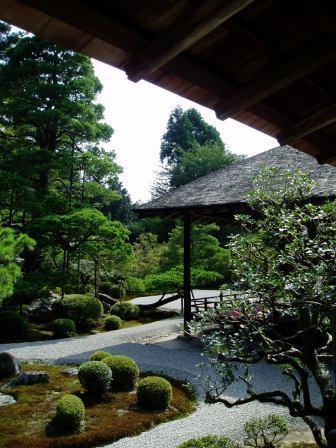
- Traditionally, a garden can be looked upon as a picture or drawing in Japan. You can say the garden is the center of the temple. I mean they designed houses for the places to enjoy watching the gardens. In most cases, they describe seceneries seen in forests deep in mountains because they need them to see their survival game in the present world in perspective. As I should add, rich persons in Japan are expected to have such gardens with houses. The same is true of Manshu-in. There, the Imperial princes lived. They tried to enjoy that.
- Can you see the white sand in the picture on the left? It is the river running. This kind of drawing is called "Kare-San-sui." Can you see the corridor with handrails, running along the sand river? You're required to think the passage be part of a roofed pleasure boat with a tatami floor and shoji, on which Japanese enjoy watching good sights sometimes drinking. You have to walk the corridor, but in your imagination you are in the boat floating on the river to a place deep in the mountains, and you may find yourself in the Pure Land, if you immerse yourself in the drawing.
6/01/2005
Antiwar Pact
Japan has been trying to draft new laws in some of the international committees like NPT, that will bring about a peaceful society without any war, for it knows the stark fact that a war works as a game like soccer, baseball, just to decide which wins in a battle; so it does not help to judge which is right over a matter. Therefore, in the NPT meeting, Japan tried to make articles that will disarm some countries(China and US) and will prevent others(the countries in the Middle East, and North Korea) from using nuclear power strategically. But they refused it, for the proposition seems to them absurd in this real world. The NPT has been useless already. Japan has to get the seat of the permanent members of the United Nation Security Council to accomplish the purpose that it tried to attain in drafting the second article in the Paris antiwar pact in 1928.
5/29/2005
The End of the Spring
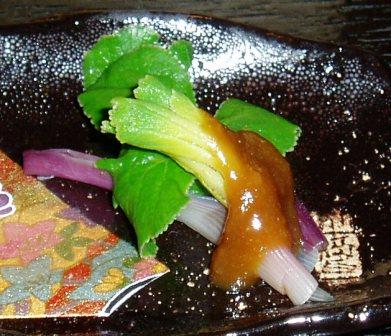 I went to Yuto, one of the authentic Japanese traditional restaurants, where I ate hamabohfu in the picture, a wild plant which grows on the seacoast and creates a wind blowing in your body after you eat it. My experience has revealed wild plants have something special that cannot be found in vegetables grown in the fields partly because wild ones have survived by its own survival power in the environment, without any recourse to human care including organic fertilizers.
Hamaboufu heralds the end of the spring and the beginning of the season in June, in which it rains very often.
Subscribe to:
Posts (Atom)