7/31/2005

My Kyoto Memory

I went to Kyoto with my friends last week. There are so many sights to see, but I wanted to watch most the temple of Manshu-in(曼殊院), located in the north east part of Kyoto. Its name comes from a Bodhisattva in Sanskrit, but it is not a Buddhistic temple in nature mainly because in the Edo Era many of the imperial Princes were required to live there as Buddhistic priests lest they should participate in the politics.

The prince who built this was Ryo-sho-Ho Sin-no (良尚法親王: 1622-1693), whose father, Tomohito Sin-no, was frequently invited to tea ceremonies hosted by Toyotomi Hideyoshi, the person in power during the second half of the Aduchi Momoyama Era, who tried to be a court noble to keep his dynasty secure. They came to have a close relation. Probably, that's why Tokugawa Ieyasu, the person in power during the Edo Era following Aduchi-Momoyama Era, should have disliked and tried to exclude the court nobles.

I got interested in Manshu-in because I saw some of the beautiful pictures of Manshu-in in some books, websites, and magazines. Then I read some of the articles about Manshu-in written by my favorite author, Siva Ryotaro, who stopped by Manshu-in to see the garden every time he visited Kyoto, and I was itching to see the garden of Mansu-in. Here are some features of the garden below, he mentioned.
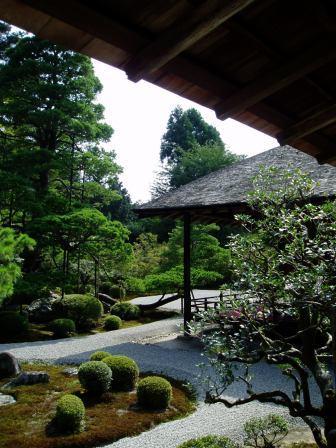
  • Traditionally, a garden can be looked upon as a picture or drawing in Japan. You can say the garden is the center of the temple. I mean they designed houses for the places to enjoy watching the gardens. In most cases, they describe seceneries seen in forests deep in mountains because they need them to see their survival game in the present world in perspective. As I should add, rich persons in Japan are expected to have such gardens with houses. The same is true of Manshu-in. There, the Imperial princes lived. They tried to enjoy that.
  • Can you see the white sand in the picture on the left? It is the river running. This kind of drawing is called "Kare-San-sui." Can you see the corridor with handrails, running along the sand river? You're required to think the passage be part of a roofed pleasure boat with a tatami floor and shoji, on which Japanese enjoy watching good sights sometimes drinking. You have to walk the corridor, but in your imagination you are in the boat floating on the river to a place deep in the mountains, and you may find yourself in the Pure Land, if you immerse yourself in the drawing.

7/13/2005

No Justice

Japan is going to be isolated because it is trying to get back the abductees from North Korea in the meeting of the six countries, the US, Russia, China, South Korea, North Korea and Japan. You know, North Korea was a communist country, so it tried to communize and absorb South Korea into One Korea. Then, it abducted more than 100 Japanese to use them as secret agents for North Korea. It was a terrible crime or terror. You should imagine you're suddenly kidnapped and sent to North Korea, and you are forced to live there and to be trained as a secret agent. They have never seen their parents for more than twenty five years. Don't you think it's bitter? But the other four countries, the US, Russia, China, and South Korea, have decided to ignore the evil crime. I'm very disappointed because the problem of on which side is justice is going to be handled by whether you have nuclear weapon or not. Rather, it seems to me, a Japanese, that they are going to isolate Japan as they did to Japan in the first half of the 20th century. Do you know what it means? Isolation is the first stage toward attributing complicated and unresolved matters to the country isolated.

7/02/2005

A remark on a report by a Chinese

Today, I found and read a report written by a Chinese who were interested in Japanese Nobel Prize Winners in Literature, came to Japan to study some of them for three years and came to hate Japanese because he felt discriminated and underestimated there. Now he is back in China, leading some group protesting against Japan. In the report, he explained how he came to dislike Japanese. He attributed his hatred toward Japan not to the brainstorming imposed on the Chinese but to his encounter with Japanese scorn for Chinese during his stay in Japan. He even found the sign "No Chinese" in front of a bathhouse in Japan. According to him, more than 90 percent of those Chinese who come and stay in Japan should become anti-Japanese, even though he loved Japanese culture before coming to Japan.

The report, he says, is the first chapter of the six. The other chapters, not published yet, are designed to describe 1) Japanese are ignorant of China and Chinese, 2) The good relationship among the East Asian countries (China, Korea, and Japan) has been destroyed by Japanese ally with the Western countries, 3) Japan is preoccupied with the illusion it has been superior to China, 4) China is requiring Japan not to give China much money but to show something sincere, and 5) Japan should ally with China to create a peaceful relation among China, Korea, and Japan, and to change the power balance in the world.

I love to read all of them. I cannot wait. The five topic sentences are attractive enough to drive me make small comments on them.

Concerning 1 and 3, I cannot say he isn't right. Some of us have categorized China as a developing country, based on the western standard of "progress," and we've been forced to update our concept of China. Now many of us recognize they don't know about China as well as Korea. But I would say this is vice versa. They don't know well about us, either.

As to the sign of "No Chinese," I'm not sure exactly why, but many of us guess some conflicts got the owner to hang out the sign. I would say they should have been caused by some cultural differences in manner, especially in distinction between public and private spheres. Bathhouses are both public and private places in Japan. There, you're required to keep some rules in your minds. I mean some Chinese would violate some of the rules common to many of Japanese. The owner, I would conclude, should have tried to preclude the bad-manner reputation because s/he was afraid Japanese customers would not come to the bathhouse.

It would be hard for me to explain and define all of the deeds that may look tacky to most Japanese. You know, customs and etiquettes in many cases refuse logical explanation. Japan has been an isolated island country since its birth, so it has engendered some cultural manners that may look absurd or illogical to you. And let me tell the Chinese it would take much more time to be familiar with a culture alien to you. Some say your three year stay would make your host country look so bitter. I have studied in a graduate school in US, but I would not like the US unless I had got two kind American friends there. The impression of a host foreign country, I would say, depends to some degree upon your company there in the first stage of your conformity to the country.

Additionally, Chinese are notorious for two reasons. First, I hear that many of Chinese don't adjust themselves to foregin environments even if they have to settle there. More important, we're scared of the Chinese because we know they come to Japan to earn just money, even if they dislike and hate Japan, and then commit crimes. Of course, it may be just rumors. But if your countrymen are assaulted by some persons belonging to one single group, some of us should be so scared of the whole group as to make a rule to preclude them. Anyway, we need to talk for mutual understanding.

His assertions in 2 and 5 sound quite interesting and right, but this is a matter of ours, as was in the early stage of the 20th century. One of the Japanese intelligensia proposed then Japan should get out of the East Asia to survive in the World revolving on the Imperialism. We don't think the judgment was the most appropriate, but we don't criticize it as the most inappropriate. Let us think about it, anyway.

The statement in 4 concerns historical matters. We're wondering why some of the Chinese like to criticize Japan referring to what it did in the past in spite of their recognition that Japan was not quite cruel and evil. The late Chinese leaders, like Deng Xiaoping, Chiang Kaishek, and Mao Tse-tung, suggested that Japan should not be blamed in their writings. I cannot trust those Chinese who know they should not criticize Japan but have criticized it for their own purposes.

6/19/2005

remaining or forged?

Did you see the pictures? I don't understand why they need to let their children inherit such hatred against Japan from the children's great grandparents? I partly understand they cannot forgive those who killed their parents and relatives, but I don't think it good to teach them such hostility in public school. I would say the antipathy has not remained but been forged in their minds to create their own nationalism that their great grandparents really wanted to be against Japan and other imperialistic countries 100 years ago. If they want to make their occupation of Liancourt Rocks secure, they only have to leave the case to the World court, as suggested by the Japanese government. I'm afraid now some of the Korean children will offend and assault the innocent great grandchildren of the Japanese who colonized Korea 100 years ago, and that the South Korean government has no intention to be friendly with Japan. I would say they need it as the only available virtual enemy to encourage their people to work and study harder to get the country to be strong enough to assuage their anger and anguish against themselves in the past, who did nothing for their country. I would also say I could share those feelings, though.

You could read this to learn that the US supported South Korea to create the hostility to some degrees after the WWII.

6/01/2005

Antiwar Pact

Japan has been trying to draft new laws in some of the international committees like NPT, that will bring about a peaceful society without any war, for it knows the stark fact that a war works as a game like soccer, baseball, just to decide which wins in a battle; so it does not help to judge which is right over a matter. Therefore, in the NPT meeting, Japan tried to make articles that will disarm some countries(China and US) and will prevent others(the countries in the Middle East, and North Korea) from using nuclear power strategically. But they refused it, for the proposition seems to them absurd in this real world. The NPT has been useless already. Japan has to get the seat of the permanent members of the United Nation Security Council to accomplish the purpose that it tried to attain in drafting the second article in the Paris antiwar pact in 1928.

5/29/2005

The End of the Spring

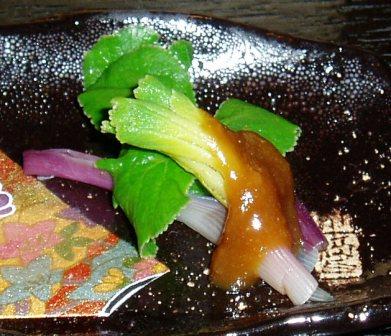
I went to Yuto, one of the authentic Japanese traditional restaurants, where I ate hamabohfu in the picture, a wild plant which grows on the seacoast and creates a wind blowing in your body after you eat it. My experience has revealed wild plants have something special that cannot be found in vegetables grown in the fields partly because wild ones have survived by its own survival power in the environment, without any recourse to human care including organic fertilizers.
Hamaboufu heralds the end of the spring and the beginning of the season in June, in which it rains very often.

5/27/2005

Anti Binary Oppositions

A Japanese was killed in Iraq, who was employed as a bodyguard or something in a company. We will never forget two innocent Japanese have been killed in Iraq. Japan may have looked offensive to some in supporting the USA in the war and sending the army there, but we're adamant that the Japanese army was sent there to keep some area ivolved peaceful. I mean Japan was trying to play a different role in Iraq from the ones any other country did. You will see how many of Japanese dislike binary oppositions after studying about Japan. Our detachment from the oppisitions, which may seem to be vague, would be found in the history of Japan except in the first half of the twentieth century. Anyway, we will never forget those killings while I know some would think Japan was against them.

5/01/2005

Tragedy

Last Monday a tragedy happened in Japan. A train got derailed and crashed against a big apartment built along the rails, and about 100 persons passed over so far. Each of them had their own lives, which they expected to be continuing more....

A lot of stories have been narrated here concerning the persons who cannot tell us any longer about themselves and anything that they were going to do on that day and the days to follow. One of them was a girl, who lost her mother several years ago and had played the role of the mother in her family. She encountered the accident on the way to her first overseas trip to Korea since her mother's death.

An accident takes place anytime anywhere. Seeing that disaster, a Japanese is led to think he or she might have incurred that tragedy, while some of us thinks it was caused by mistakes of the motorman or the company that gave him a tight schedule or much pressure. I belong to the former.

I was most depressed when I heard a saying of a middle-aged man who was bereaved of his wife. He said, "I don't know why my wife encountered the accident because I didn't think she had done what God dislikes. We have been working diligently without committing any harmful things, ... I don't know why God gave it to my wife."

Some facts are difficult to overcome or accept. What should you do when you encounter such tragedies like the deaths of the persons you cherish most? Can you give me or him an answer?

4/28/2005

Mistake

I have to be sorry because I made a mistake. I found the mistake in one of the articles I posted here, about the unavoidable four pains in Buddhistic view. A book on Buddhism, I have finished reading recently, illustrates the true meaning of the pains, "duhka" in the original language. Some Buddhistic books written in about 100-200 BC showed the pains referred to the unavoidable pains. But the book reveals "duhka" means the situation in which you have to think more or in which you are so ignorant that you see a phenomenon in terms of binary oppositions. Sorry.

4/24/2005

Japanese textbooks

Etymologically, "history" means "one who sees or knows," and, in Latin or Greek, "learning by inquiry." That is, "history" is a subject for those who are not content with what they have learned, and think they have to know more. Let me tell you Japanese people has got a biggest information about what happened around Japan from 1900 to 1945 because they've been required to face up to what their grandfathers did during the war, and have had to ask themselves, "why has Japan been blamed for what it did during the period?"

We know invasion is so bad, and if our grandfathers did it to the Koreans and Chineses we ought to feel sorry for that, as our grandfathers would do so. But we cannot help starting with "but...". Because our survey on many records and reports about the war, available to us now, has compelled us to wonder why only Japan has been criticized so bitterly as to be called the evilest country that had ever existed in the history of the Earth. Japan was bad, indeed, to colonize Korea and assault China, and to make the surprise attack on the American army at the Pearl Harbor. But let me ask you if other countries including China did not do anything harmful or cheating during that period. Our survey reveals the war was not so simple. The situation was so complicated. The textbooks to be adopted in Japanese school, called nationalistic in some medias in the world, referred to what other countries did during the war, to describe the world as it was, so I don't think it is trying to legitimate what Japan did during the war. It just wanted to give children as accurate an description of the world in the first half of the 20th century as possible.

4/17/2005

Another big difference

Available through the internet to me are more than 50 newspapers, domestic and foreign, which let me find several perspectives, from which an event is retold and reiterated to me. Looks like a possible whole picture of it comes to me, though a perfect view cannot be drawn by a human being, I guess.

Japan is an isolated island country, into which many of Japanese were so confined that I felt as if we were prohibited from assuming a wide view over what was happening the world. I might be sensitive, but I always feel uneasy when thinking about the small island country in the big world.

It seems I may be a little bit dissed....

4/15/2005

To Koreans and Chinese whom it may concern,

Let me explain how Japan seems to have justified what it did during the war. It's because it has begun to distinguish between wrong and non-wrong things that it conducted during the wars from 1900 to 1945. We began to do that because we don't want to commit wrong things again. In order not to do that, we need to know the exact reasons. In another expression, the awareness of the reasons would not lead our children to make the same mistake our grandfathers made before. Therefore, some of us began to distinguish between them and trace the causes of the wrong deeds only. More important, the war should be seen as it was; otherwise, we will not be able to know the true causes.

But we don't think Japan was right in invading your countries. We agree with you that, whatever reason, Japan should not have followed the imeperialistic policy even if it was adopted by several Powers, against which Japan was fighting except you two. But Japan found no other way but to follow that. Therefore, the government has apologized for that, and many of us don't think the government should withdraw the apologies it has expressed to you.

In short, Japan has done two different things at once recently. It has apologized for what it did against you during the war, and tried to find the true reasons why it committed the wrond deeds because we don't want our children to reap the causes when they grow. This might be fullfilled when the war is seen as it was. And some of the Japanese deeds have been found that do not seem to be so wrong. But again, we're not going to justify what our grandfathers did against you. In other words, apologies cannot be enough to show our determination of not making the same mistakes.

4/13/2005

Korea is different from China

Some of the riots in China to protest againt Japan 1) making a bid for a permanent seat for the UNSC, and 2) allegedly distorting some of the descriptions in the textbooks adopted in Japanese schools have been reported in the world, but some of the mass medias fairly pointed out that that was a fake. Most of Japanese were relieved to see the news. I hope China would understand cheating and unfair propaganda would make China look a second-rate country.

Korea has also been protesting against Japan for the same reasons, but this country is different from China, you should notice. Korea has been struggling to change. Some of the professors in Korean universities are beginning to admit that Japan was not quite evil in invading Korea. That is, they are beginning to know how the war looked not only to Korea but also Japan. A war is not so simple as to be attributed to one single cause. Japanese invasion over Korea was also caused by complicated circumstances.

4/10/2005

different interpretations.

There has been much conflict between Korea and Japan, concerning some of the descriptions in Japanese history textbooks. This is attributed to the difference of the system in which textbooks are adopted in school. In Korea, the government chooses the one single description about a historical event, while in Japan the government is prohibited from intervening in the process. In the beginning, event cannot be an event without being articulated; therefore, an event reflect a certain view. Historical events will be open to different interpretations. Japan was defeated, but Korea cannnot attribute all the sufferings they experienced during the war time, to Japan.

4/02/2005

Intelligence

I thought Gulliver's Travels was written just for children. But I have to admit I was mistaken. One of the remarkable phrases in the work is "Reason taught us to affirm or deny only where we are certain; and beyond our knowledge we cannot either. So that Controversies, Wranglings, Disputes, and Positiveness in false or dubious Propositions, are Evils unknown among theHouyhnhnms."

I saw the report by the commission ordered by President Bush to trace the misjudgement about the weapons in Iraq. After reading that report, I brought myself to wonder why we need intelligence. It should be used to judge troubles beyond our knowledge. If they don't judge, that failure of such a magnitude may be avoided.

But this is also incorrect. President Bush would tell me that not all of the human beings have had reason, so we need to get accurate intelligence timely.

3/22/2005

What is the Buddhahood?

What is the Buddhahood, the ultimate goal for Buddhists? It is the stage on which you can do two things; first, you love others like you love yourself, and second, your every act, voluntarily or involuntarily, gives much joy to any other living and non-living things in this universe.

Some of you would wonder on what doctrine or from what view buddhists would think it possible. It's because of the Buddhistic view that each of any living and non-living things should look different in this world, but actually they are parts of the single whole entity. In Buddhism, any living and non-living things you can see through any medium in this world are regarded as amalgams of materials in which older materials decay and are replaced with new ones continually. It follows that some pieces of your body will be useful in other living or non-living things in the future, while the other fragments may have been parts of the body of a Lion in Africa. It means we, including of all of you, belong to the one. This realization enables you to love others, living or non-living, deeply and involuntarily as you love yourself. The second advantage will come to you when you see the realization a fact, not a realization. Buddhism, in a sense, you can say, shows the ways how you see the realization a bald fact.

3/20/2005

How to avoid the four unavoidable pains in Buddhism

To avoid the four unavoidable pains in Buddhism, you have to change your view of the world as found in the movie of The Matrix. What makes you afraid of the pains are mind, words, and a body. Your body enables you to see, feel, hear, touch what is going on around you. Those information should be processed through your mind into words, a cetain extant things in the world. You know you are going to perish. You have seen or heard about the death. The word of death makes you afraid of the death. Consequently, you only have to control the working of your body, mind, and words. So the first step toward the Buddhahood is practice controling them.

3/18/2005

The Unavoidable Four Pains in Buddhism

Why am I here? Why was I born? Nobody asked me if I would want to be born in this world. I'm here, I'm living. I have to try to survive, but I know I shall die. Why do I have to live knowing I would die? The same feelings come to me when I had a flu or disease. I haven't allowed any virus to assault me. How did they do that in my body? These, life, aging, disease, and death, are called the unavoidable four pains in Buddhism. Every person cannot elude any of them.

3/16/2005

MacArthur and Takeshima

Takeshima is a tiny island 150 kilometeres away from the mainland of Japan, and 117 kilometres away from Korea. This is one of the issues between Japan and Korea. Takeshima had belonged to Shimane Prefecture in Japan since 1659 and been recognized so internationally since 1905.

In 1941 the war happened and in 1945 Douglas MacArthur came to Japan as the President of the GHQ. He, when leaving Japan, took the rights of surpervising Takeshima temporarily as well as Okinawa and Ogasawara islands, and gave them to the American Army in Korea. Okinawa and Ogasawara islands were returned to Japan soon but Takeshima was neglected. Probably, the Americans must have forgotten about that island because it was so small an island that it was not found in the maps used before in Korea(but Korea alleges that Takeshima was discovered by a Korean in the 6th century). In 1953 Korea began to say "it is ours." Japan has made claims about this and the US agreed, but Korea ignored that protest and put the army over the island because Japan was not allowed to use the army.

This case should be judged depending on the international law, which says an unidentified island should belong to a country which has owned it for longer time without any trouble. Japan has the fact, but Korea didn't, so Korea needed to create the fact that Korea supervised the island peacefully. One of the ways for Japan to prevent Korea from continuing the illegal occupation of the island is arousing a trouble. Simane Prefecture passed the article by which the day is set of the 100 anniversary of the island's being owened by Shimane Prefecture. Some Koreans called this decision evil. I cannot understand them, but we also know the reason. In Korea, like in China, they learned the limited history, because the governments choose what should be taught to them to arouse nationality and loyalty in the nations(you can see in the textbooks in Korean school the description that Takeshima was one of the areas invaded by Japan in the WWII) . Anyway, when watching a Korean cutting his or her finger, I didn't find what Japanese should do.

But now I know. I should let many of them know the fact that they have been taught distorted facts. So i wrote this.

3/04/2005

Mystery or Miracle

Some pieces of the first movement of a good Bruckner's Symphony No. 7 floated to me while I was still sleeping. My body remained resting but my mind worked well enough to wonder how this music was being played, because the CD should have been buried in a corner of one of the bookshelves in my room for so many days that I couldn't locate it. The only information I inferred was my wife picked it up in the CDs piled up and put it into the place. The questions that had been filling me up with were sorted through my scrutiny and reduced into the one: how could she choose the one?

On that day, in the evening, I was going to a fifteen-years-old city theatre to listen to Symphony No. 7 of Bruckner, played by GewandhausOrchestra Leipzig and conducted by Herbrt Blomstedt. But I chose this neither because the orchestra and the conductor were great nor because I love Bruckner. Those could not be enough for me to decide to buy an expensive ticket for that concert on the day, the deathday of Mr. K, a teacher who taught me Faulkner and classical music. He was said to be queer in aesthetics, but I shared it with him. And he also loved Bruckner, as I do. When I found a poster to let us know the concert would be held, it was as if his motto reiterated in my mind, "something moving can be the motif for you to live, work, and survive in the world, so you have to keep your sensibility working; therefore, you have to give yourself so many opportunities to move you." And I also remembered how happy he looked when he was preparing to leave his office for the concert theatre to listen to Bruckner, who was his cup of tea.

My wife, I guess, is an esoteric buddhism worshipper in some cases. You know, Esoteric Buddhism would be a little bit different from other sects of Buddhism in that, according to the doctrine, you could be allowed to get a magical power or a clearest insight to enable you cause miracles. Probably, on that day, she got the power, so she picked up a Schricht's Bruckner No. 7. without knowing anything about the concert and classical music. She is not interested in classical music as art but as a cradle song. Nevertheless, she chose the one the teacher mentioned as the best conductor for Bruckner's No. 7.

Blomstedt performed terribly cool and great. I clapped so much, murmuring "thanks, Mr. K."